Williams Center for the Arts
8:00 pm
Program
Mock Morris (1910)
Percy Grainger (1874 – 1961)
Transcribed by Dana Paul Perna
Performed without a conductor
Soloists:
Julia Sealing, saxophone
Begun on May 19 and completed by June 4, 1910, Mock Morris began life dished-up for six single strings, or string orchestra. Its solo piano version followed (in Grainger’s autograph) with the dedication, “Birthday gift, Mother, July 3, 1910,” bearing the whimsical title “Always Merry and Bright.” Inscribed on the source materials for this transcription, Grainger, by his own hand in 1950, wrote: “The rhythmic cast of the piece is somewhat Morris-like, but no traditional tune-stuffs are used. It was inspired by the motto ‘Always Merry and Bright.'” (Perna)
Mock Morris is a buoyant, jaunty romp, inspired by the traditional English Morris folk dance. There have been several settings of the work, including the aformentioned original chamber strings, string orchestra, full orchestra, solo piano, and at least two transcriptions for wind ensemble. Unlike many of Grainger’s other works, such as Lincolnshire Posy, Molly on the Shore, or Irish Tune from County Derry, Mock Morris is built from Grainger’s original tunes.
October (2000)
Eric Whitacre (b. 1970)
Conductor
Madeline Paguia ’28
Soloists:
Timothy Ayres, euphonium
David Broczkowski, clarinet
October began at a restaurant in Chicago, when I was first introduced to Brian Anderson. Brian, a high school band director from Fremont, Nebraska, knew my work and wanted to commission me, but couldn’t find the finances. If I remember correctly I didn’t immediately hear back from him, and I just assumed the gig would never materialize.
About a year later I get this phone call from him and he says that he has put together a commissioning consortium of 30 high school bands from Nebraska. 30 bands! I’ve dealt with institutional bureaucracy for a while now and I can’t possibly imagine how he brought all of those people together, let alone get them to agree on a commission.
Writing a ‘grade three’ work was an entirely different challenge. It’s easy to write your way out of a difficult corner with flashy, virtuosic material, but with ‘easier’ music your solutions must be simple, elegant, and functional. I worked hard to create a piece that could be successfully performed by all of the high schools in the consortium, yet never compromised its musical integrity. Frankly, writing ‘easy’ music is one of the hardest things I’ve ever done.
October is my favorite month. Something about the crisp autumn air and the subtle change in light always makes me a little sentimental, and as I started to sketch I felt that same quiet beauty in the writing. The simple, pastoral melodies and subsequent harmonies are inspired by the great English Romantics (Vaughn Williams, Elgar) as I felt that this style was also perfectly suited to capture the natural and pastoral soul of the season.
I’m quite happy with the end result, especially because I feel there just isn’t enough lush, beautiful music written for winds. October was premiered on May 14th, 2000, and is dedicated to Brian Anderson, the man who brought it all together.
Notes by the composer
Conductor’s Note
Through Eric Whitacre’s October, I realized a conductor’s gestures have a greater purpose beyond beating time, cueing entrances, and keeping everyone together. This semester, I strived to show (through my gestures) the delicate yet profound emotions interwoven throughout this piece. A task easier said than done. As a more reserved, cerebral conductor, I beat time more than I showed expression. Over the course of this semester, I ventured out of my comfort zone by becoming more comfortable shaping the sound I was hearing in real time. I learned what it meant to become a musician with my hands. I would like to thank Dr. Kirk O’Riordan (Director of Bands at Lafayette College) for his instruction and for the time he has given me to work on this during rehearsals. Many thanks also go to the members of The Lafayette College Concert Band, who demonstrate the same care and attention to playing the music not only for Dr. O’Riordan, but for every past and present student conductor who has graced the podium. Conducting students only learn the value of their gestures in the presence of a live band.
My hope is that as you listen to this performance of “October”, that these simple, yet powerful harmonies touch your heart as they have mine.
Vientos y Tangos (2003)
Michael Gandolfi (b. 1956)
Soloists:
Vientos y Tangos (Winds and Tangos) was commissioned The Frank L. Battisti 70th Birthday Commission Project and is dedicated to Frank Battisti in recognition of his immense contributions to the advancement of concert wind literature. It was Mr. Battisti’s specific request that I write a tango for wind ensemble. In preparation for this piece, I devoted several months to the study and transcription of tangos from the early style of Juan D’arienzo and the “Tango Nievo” style of Astor Piazzolla to the current trend of “Disco/Techno Tango,” among others. After immersing myself in this listening experience, I simply allowed the most salient features of these various tango to inform the direction of my work. The dynamic contour and the various instrumental combinations that I employ in the piece are all inspired by the traditional sounds of the bandoneon, violin, piano, and contrabass.
Notes by the composer
–Intermission–
Two Hundred Moments (2026)
Kirk O’Riordan (b. 1968)
World Premiere
Two Hundred Moments was commissioned by Lafayette College as a part of its Bicentennial Celebrations in 2026. It was performed in a smaller version by The Lafayette College Concert Band the College’s Commencement Exercises, May 23, 2026. It was subsequently rescored for full wind ensemble.
Lafayette’s motto during the year-long celebration was “This is our moment.” Indeed, in this year of celebration there have been a great many moments of reflection, pride, and anticipation of what the next two hundred years might look like for the College. It was my hope to capture as much of that energy as I could in a brief musical moment.
The piece, exactly 200 measures long, is built from fragments of Lafayette’s Fight Song and Alma mater. It is part fanfare, part reflection—it alternates between joyful celebration and quiet remembrance.
Notes by the composer
Would I Have Broke This Happy Dream? (2018)
Ashley Kushner – Kmetz (b. 1997)
Would I Have Broke this Happy Dream (2018) was composed for the Lafayette College Concert Band as my Honors Thesis project. After discovering my interest in composition as a sophomore and playing in the LCCB for all four of my years at Lafayette, the logical conclusion to my music major was to compose a piece for this ensemble. The title and story of this piece are inspired by a poem by John Donne (1572-1631) entitled “The Dream.” The first stanza is copied below:
Dear love, for nothing less than thee
Would I have broke this happy dream;
It was a theme
For reason, much too strong for fantasy,
Therefore thou wak’d’st me wisely; yet
My dream thou brok’st not, but continued’st it.
Thou art so true that thoughts of thee suffice
To make dreams truths, and fables histories;
Enter these arms, for since thou thought’st it best,
Not to dream all my dream, let’s act the rest.
The form of this piece mimics falling into a dream, existing within that reality, and eventually waking up from that dream. The main melody and waltz theme undergo fragmentations and mutations that act as though they are being remembered and misremembered throughout a dream. The moments of clarity in this piece indicate stability within the dream’s reality, which then quickly dissipate into other ideas. In waking from this reverie, ideas are more disjointed and continue to be altered, until the memory fades away.
Notes by the composer
A Hokusai Triptych (2019)
Benjamin Barker (b. 1995)
“A Hokusai Triptych” is a three-movement work, each movement inspired by a different artwork by Hokusai, a Japanese artist particularly known for his ukiyo-e prints. I selected three unrelated works, each different artistic mediums, but all depicting an animal. With each movement, I mix my own impression of each work with the historical and cultural elements surrounding them, creating a sort conversation between Hokusai and myself.
I. Whaling off the Coast of the Goto Islands. The first movement is a programmatic work and depicts the artwork rather literally. My first step in writing this movement was to do some research on the history and customs of whaling in Japan, particularly in the Goto Island region. In many pieces of Japanese folklore, the whale is considered to be a god of the sea, and it was a particularly desirable prey due to the variety of ways in which its body could be used, requiring little to no waste. It makes sense, then, that whaling had such respectfully ceremonial and spiritual qualities to it, often inspiring prayers, chants, or songs prior to setting sail. Many of these songs tell stories of whaling legends, and celebrate the fortune and longevity to come, should their hunt be successful. I used a fragment of one of these songs as the source material for this movement.
The movement begins with the introduction of the whale: low reeds and bombastic percussion communicate the splendor and might with which the whale was revered. As we reach the pinnacle of the first phrase, we begin to pull away and see more of the whale’s surroundings. The whale swims through the ocean as we begin to hear the whaling song being played on the shore, distorted and phased by the deep waters. These sounds draw the whale out of the water where we get a brief glimpse of the beauty of the outside world. However, this beauty is fleeting, as the whale has been surrounded by whaling boats and onlookers from the shore — and so the hunt begins! The hunt is turbulent and exciting, and as we reach the peak of this excitement (which, you may also notice is reference to my favorite composer, Yasuhide Ito) the whalers succeed in their hunt, and they rejoice with drums as the whale cries, and its perspective gradually fades to black. (Sorry: Having the whale survive just wasn’t as musically interesting.)
II. Requiem: Tiger in the Snow. I decided that the second movement, being inspired by one of Hokusai’s final works before he passed, would be best composed as a requiem. I thought it would be fitting given the ethereal nature of the tiger seemingly floating in front of a mysteriously ambiguous background. My goal for this movement was to combine that ethereal mood with sounds reminiscent of the cold, snowy setting from which it eminates. There is a popular lullaby originating from the Edo period (in which Hokusai lived). Perhaps, if Hokusai was familiar with this lullaby, it would make a fitting theme for a requiem. With this in mind, I decided the melodic material for this movement should stem from that lullaby.
As I reflected on the ethereal atmosphere I wanted to create, I reflected on which forms of music I have heard that sound otherworldly. I selected three kinds from what came to mind: Bulgarian women’s folk choir (for its distinct timbre and dissonant harmonies), gagaku (a music which represents the combination of heaven, earth, and everything in between), and Kagura (a ceremonial dance meant to entertain the gods). By combining these three musical inspirations, I tell the story of Hokusai in his final hours as if he were, himself, the “Tiger in the Snow” floating to the heavens. The movement ends with his final words as an outcry: “If I could have 10 more years… no, if I could have 5 more years of life, I could become a true artist.”
III. Cuckoo and Azaleas. When you read the inscription on the left side of this artwork, you get a poem which reads, “A single cuckoo by day splits the mountain bamboo / with an initial cry upon first hearing about Du Yu.” This poem refers to the death of Chinese general Du Yu, and decidedly relates this artwork to death. In order to avoid every movement of this work being related to death in some way, I decided to ignore the second half of this poem completely, and focus on the imagery present in the first half (which you hear at the end of this movement). This wasn’t quite enough inspiration, though, so I delved into the symbolism behind this artwork and found two pieces of information I used to construct this movement.
1. The lesser cuckoo (the bird featured in the work) and azaleas are known as harbingers of summer.
2. The azalea, in the Chinese language of flowers, is known as the “thinking of home bush.”
And, an additional two pieces of information I also decided to ignore:
1. A very famous legend depicts a cuckoo as crying frequently and loudly, to the point of coughing up blood. The places where said blood hits the ground are where azaleas sprout and signal the beginning of summer.
2. Sending azaleas to someone in a black vase was once considered a death threat (due to their high toxicity). How charming. Maybe some inspiration for a future work, but certainly not this one.
Throughout this movement, you’ll find musical imagery mimicking the lesser cuckoo’s birdcall and sudden, jerky movements, as well as a nostalgic-sounding melody as a nod to the “thinking of home bush.”
Notes by the composer
From the Conductor
The Lafayette College Concert Band
Assistant Conductors
William Hoelzel
Madeline Paguia
—–
Flute
Brian Morris, Principal
Emily Kozero
Sarah Acosta
Emma Martin
Owen Rudolph
Jamie Lin, piccolo
Oboe
Kaia Frazier
Liv Bamford
Clarinet
David Broczkowski, Principal
Ben Alter
Ashley Kushner-Kmetz
Emily Rice (Eb)
Aram Ramsay
Abigail Nickels
Sungbum Lee
Kaitlin Brill
Brooks George
Christopher Ruebeck
Bass Clarinet
Peter Rice
Bassoon
Alexa Krabbe
Nathan Leine
Katie Rice
Saxophone
Julia Sealing, Principal (alto)
Madeline Metzger (alto)
Rocky Luan (alto)
Ruben Bucciarelli (alto)
Alex Kmetz (alto)
Andrew Manni (tenor)
Atlee Zimmerman (tenor)
Elisa Massa (baritone)
Horn
Madeline Paguia, Principal
Mariella Morales
Gillian Grabowski
Nicholas Pignolo
Trumpet
Corey Stein, Principal
Robert Leiter
Charlotte Konopada
William Blair
Trombone
Jackson Eshbaugh, Principal
Nolan Sirgany
Jazz Smith
Pedro dos Santos
Bass Trombone
Benjamin Zwicker
Euphonium
Timothy Ayres
Andrew Bauer
Tuba
Arman Mecklai
Jack Kerekes
Mikayla Tanzos
Nick Sears
Piano
Ben Alter
Percussion
Will Hoelzel, Principal
Joe Freeston
Noam Raich
Henry Schrader
Gabe Sack
Grace Farah
Parker Heyen
Cameron Katry
Graduating Seniors
Lafayette Faculty/Staff
LCCB Alumni
Guest Performers
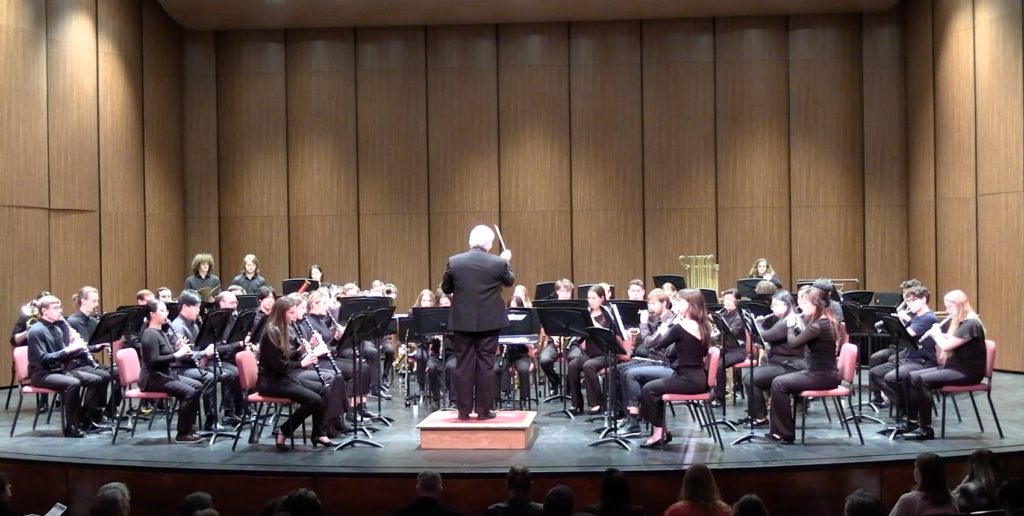 The Lafayette College Concert Band is comprised of approximately 50 students, faculty and alumni from a variety of majors who are united by a strong desire to perform the highest quality music at the height of their abilities. Participation in LCCB is open to students in any major as well as faculty and staff. The ensemble is conducted by Kirk O’Riordan, Director of Bands and Associate Professor of Music.
LCCB typically performs one concert each semester. The repertoire is selected from traditional concert band masterpieces, newer works by established and emerging composers, commissions, and orchestral transcriptions. Past concerts have included works such as Husa’s Music for Prague 1968, Bernstein’s Symphonic Dances from West Side Story, both Holst Suites, Grainger’s Lincolnshire Posy, and Mussorgsky’s Pictures at an Exhibition. LCCB has premiered works by composer/conductor Kirk O’Riordan and 2010 Pesky Artist in Residence William Pfaff as well as Ashley Kushner ’19 and Zach Jones ’13.
Students enroll for 1/4-credit. Open to all students, faculty and staff, LCCB employs a wind ensemble model for instrumentation. A seating audition is required before the first semester of participation. Due to the large numbers of flutists, clarinetists, saxophonists, and trumpeters, the number of available seats in these sections may be limited.
 Several opportunities for leadership in the ensemble are available for highly motivated, experienced players. Principals in each section lead sectional rehearsals and help the less experienced players with technical issues. The Assistant Conductor is a highly advanced musician who has been studying conducting for at least one year prior to serving in the position. She/he conducts the ensemble on at least one piece in performance, having led all the rehearsals for that performance. Typically, that person also leads Pep Band and conducts the annual Marquis Players musical production. Finally, the LCCB President is nominated and elected by the student membership of the ensemble. This person works with the director and the Assistant Conductor on administrative tasks as a representative of the students.
Kirk O’Riordan, Conductor
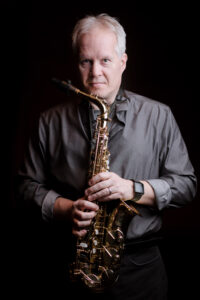
Kirk O’Riordan (b. 1968) is a dynamic force, captivating audiences as a saxophonist, composer, conductor, and educator. Dr. O’Riordan joined the faculty of Lafayette College in 2009, and serves as Associate Professor of Music and Director of Bands, teaching courses in music theory, and composition. His journey in academia also includes appointments at Bucknell University, Susquehanna University, and Lock Haven University.
As a saxophonist, Kirk has performed regularly at the World Saxophone Congress, the US Navy Band International Saxophone Symposium, and at regional and national meetings of the North American Saxophone Alliance. A frequent recitalist with pianist Holly Roadfeldt, Kirk’s programs regularly combine his own compositions and transcriptions of art song with works from the standard repertoire for saxophone and piano. In addition, he performs his own multimedia works that feature 4K video and immersive audio.
Kirk O’Riordan’s compositions have been referred to as “unapologetically beautiful” and are often praised for their uniquely “visual” qualities that depict a wide range of striking moods. His debut compact disk, Strange Flowers, was released by Ravello Records in November, 2013 and was praised by Audiophile Audition as “one of the most impressive and beautiful collections of chamber music I have heard in a while….This is all just so lovely and invokes exactly the emotions that good music should be able to induce in all of us.” Gramophone Magazine praised O’Riordan as “a composer for whom imagery is a defining inspiration….[he] is a deeply sensitive composer who savours going gently into the night.” (April 2014).
His recording of his Twenty-Six Preludes for Solo Piano—by pianist Holly Roadfeldt—has attracted similar praise: “are similarly atmospheric and proceed to unfold like a magical tapestry. Each of the 26 Preludes seemingly comprising of warp and weft forming a myriad of pixels of little pictures that ultimately combines to form a moveable feast for both eye and inner ear. O’Riordan’s miniatures are informed by languorous beauty and profundity, the lyrical variations of each often feature elaborate embellishments, as well as sudden dissonant figurations that seem to mimic the gravity-defying leaps of the gazelle…” (World Music Report, April 2017).
Recordings of Kirk’s works appear on the Crystal Records, Ravello, Centaur, ERM-Media, and EnF labels, and feature performances by Kenneth Tse, Frederick L. Hemke, Holly Roadfeldt, The Kiev Philharmonic, Ann Moss, and Farrell Vernon among others. His opera, <em>The Masque of Edgar Allan Poe</em>, a one-act chamber opera based on Poe’s “Masque of the Red Death” on a libretto by Lafayette College colleague Lee Upton, was premiered by the University of Delaware Opera Theater in November, 2016 and subsequently performed at Lafayette College. Since the pandemic, Kirk has focused his creative energies on music for saxophone: these pieces have included among others his Sonata for Alto Saxophone and Piano, <em>Sacred Spaces</em> for Alto Saxophone and Wind Ensemble, and ten large-scale works for saxophone and multimedia—most of which he performs live.
Dr. O’Riordan conducts the Lafayette College Concert Band and Contemporary Music Ensemble. During his time at Lafayette, the Concert Band has been hailed for its ambitious and adventurous programming, having performed works such as Husa’s <em>Music for Prague 1968</em>, his own orchestration of <em>Pictures at an Exhibition</em>, and world premieres by O’Riordan, Anthony J. Lanman, Ashley Kushner, Justin Kogasaka, Zach Jones, Pete Deshler, and William Pfaff.
Kirk has studied saxophone with Frederick L. Hemke, John Sampen, Eugene Rousseau, and Iwan Roth; composition with Rodney Rogers, Randall Shinn, James De Mars, Glenn Hackbarth, Jay Alan Yim, Burton Beerman, Marilyn Shrude, and Donald M. Wilson; and conducting with Steven W. Pratt. He holds the Doctor of Musical Arts degree from Arizona State University (the first recipient of that degree from ASU); the Certificate of Performance in Saxophone from Northwestern University; and three Master of Music degrees (composition, saxophone performance, and conducting). In his free time, Kirk is an avid fan of Obstacle Course Racing.
Kirk is a Conn-Selmer Regional artist.


The College Store carries Lafayette Bands merch!


Order online or stop in to the store….10% from every purchase helps the Lafayette College Pep Band replace its old marching instruments.
Blurred Days CD
 Like many bands and other performing ensembles across the country, we have had to adapt to the pandemic. For us, this has meant that we have not been able to work together, in person. This has always been a band that thrives on its sense of community, and not having that has been hard on all of us.
But rather than mourn what we have lost, we have searched for opportunities within our remote format that are unique. Working in isolation has allowed us to re-examine the possibilities of the Wind Ensemble as an entity—to re-imagine what is possible with this collection of sounds.
The five pieces on this CD were written especially for us, and especially for our situation. Each of the pieces was conceived to take advantage of techniques that would not be possible in a traditional concert—effects on a person-by-person level, or writing for flutes in their lowest register.
To make these performances, each student recorded his or her part on their phones or computers and uploaded them to either a shared drive or to the web-based recording service Band Lab. Katie Rice assembled the tracks and performed the first round of editing. I took the tracks she finished and combined them into the final product, completing the pre-production audio work.
Every student has a unique track in the recording, which allows us to use studio effects on a person-by-person level. With many of the pieces, the individual parts were created to be non-linear—we could create specific sonic effects and duplicate them in the recording software. Several of the pieces incorporate improvisation, narration, and other unconventional techniques.