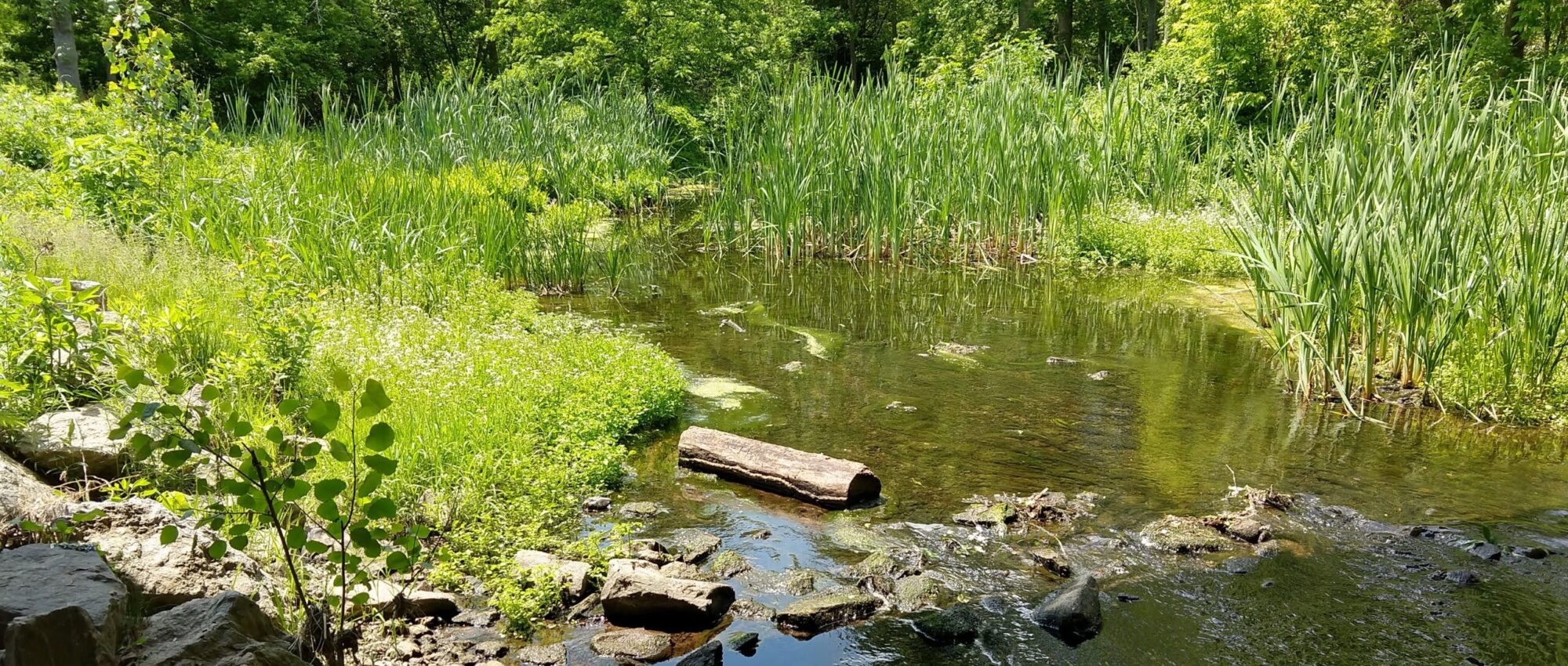
We examine relationships between hydrology and water quality in natural and human impacted (urban and agricultural) settings using data analysis and hydrologic modeling.
Our research group is motivated by two fundamental questions:
(1) How is the function of watersheds (ie., hydrological processes and water quality) influenced by watershed form (ie., the components of a watershed, including the geology, soils, climate, weather, vegetation, and more)?
(2) How are the relationships from (1) modified by human activity?
Current research projects in our lab include:
Improving understanding of spatial-temporal drivers of stream temperature: Stream temperature is a water quality indicator as well as a tracer of hydrological processes. Our research group’s goal is to better link stream temperatures to what is happening in a watershed, as well as extreme events like droughts, to better understand what makes a given river more or less sensitive to change. As part of this work, we also aim to understand how the presence of impervious surfaces impacts stream temperatures. This material is based on work supported by the NSF under Award No. 2208396. Read more about Christa’s NSF-funded project here.
- , , , et al. 2026. Groundwater Temperature Processes and Patterns: Implications for Stream Thermal Regimes. Wiley Interdisciplinary Reviews: Water13, no. 2: e70062.
- , & (2023). The heat is on: Predicting urban stream temperature responses to summer storms. Hydrological Processes, 37(11), e15033
Characterizing headwater stream functioning and knowledge gaps at national scales: Headwater systems are incredibly abundant parts of the landscape. The challenge of understanding what drives headwater stream functioning is one of monitoring (we have lots of data but it’s located in specific areas, while many parts of the US and world go unmonitored) as well as one of variability (given their ubiquity, we still don’t fully understand what makes two proximal headwater watersheds behave differently). As part of a USGS-EPA funded synthesis project, our research group has been contributing to ongoing efforts to address these big questions.
- , , , et al. 2026. Streamflow and Surface-Water Presence Data Availability Across the Conterminous United States: A Review for Headwater Systems. Hydrological Processes40, no. 5: e70572
- Golden, H.E., Christensen, J.R., McMillan, H.K. Kelleher, C., et al. (2025). Advancing the science of headwater streamflow for global water protection. Nat Water 3, 16–26
Exploring how streamflow regimes and water quality are altered by urbanization: When we urbanize landscapes, we fundamentally alter the partitioning of water at and below the land surface. However, these impacts are complex, and differ from place to place. To better relate watershed form and function in urban landscapes, we have several ongoing projects using publicly available timeseries and geospatial datasets in cities across the US.
- Hurley, R., Brandes, D. and Kelleher, C. (2024), Drivers and Buffers of Stream Flashiness in the Mid-Atlantic United States. Hydrological Processes, 38: e15302
Understanding how beaver-based restoration may alter hydrological behavior: While winding down, our research group has been working out in Lander, WY for several years observing how stream environments change in response to the installation of beaver dam analogues, a type of stream restoration structure that aims to mimic the benefits of natural beaver dams. We use a combination of drone-based imagery assessment, geospatial analysis, hydrologic monitoring, and sensor observations to characterize this response. This material is based on work supported by the NSF under Award No. 2208396. If you’d like to learn more about our project, please watch a recording of our presentation to TNC WY scientists here: link to recording. You can also read more about our work here.
- , , and . (2026). Assessing the Effects of Beaver Dam Analogues on Valley Bottom and Watershed Storage at a Site in Central Wyoming. Hydrological Processes40, no. 1: e70381