Month: September 2018

ACM Tapia Conference 2018: “Diversity: Roots of Innovation”

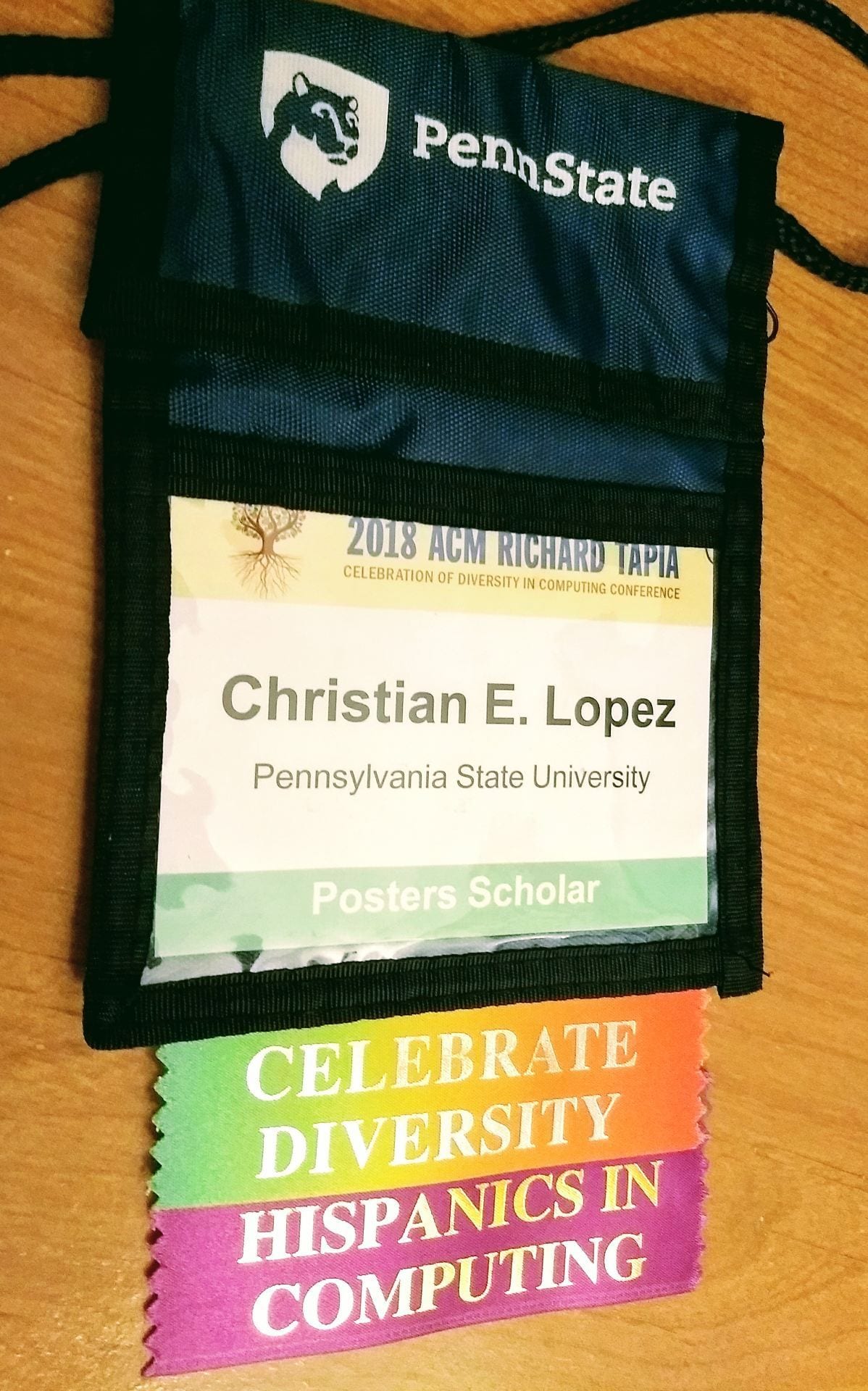
Once again, I was awarded a Tapia Scholarship to participate in the 2018  Association for Computing Machinery (ACM) Student Research Competition (SRC) at the Richard Tapia Celebration of Diversity in Computing Conference (Sept. 19-22, Orlando, FL). In this competition, I presented my work titled “Towards personalized gamification to promote physical activity.” In this work, we presented a machine learning method that utilizes facial keypoint and heart rate data of users to predict their performance in physical gamified tasks.

This years conference was an extraordinary experience. I had the honor to meet the man of the hour, Dr. Richard Tapia. I was able to personally thank him for all his work on promoting and advocating for diversity in the STEM fields and making the ACM Tapia conference a reality, which each year keeps on growing. Here are just a few pictures of the conference and Dr. Richard Tapia. (more pictures to come…)
 

ASME 2018 International IDETC/CIE Conferences

The American Society of Mechanical Engineers (ASME) 2018 International Design Engineering Technical Conferences (IDETC) & Computers & Information in Engineering (CIE) Conference was a great experience. I had the chance to present my research and discuss with other researchers possible venues for future research. The conference was an excellent opportunity to learn about the state-of-the-art research in the field of Engineering Design and how Machine Learning is impacting the field.

I presented the work done in collaboration with Dr. Scarlet Miller and Dr. Conrad Tucker, titled: “Human Validation of Computer vs. Human Generated Design Sketches,“(see PDF)(see presentation) which was one of the few selected papers invited to the upcoming Journal of Mechanical Design special issue. In this new work, we expanded our research done on the functionality of sketches generated by deep learning generative models and explore the factors that affect humans perception of computer generated sketches as well as the value of using crowdsourcing to evaluate new computer generated sketch ideas.

In addition, we presented the work done by Kevin Lesniak and Dr. Conrad Tucker, titled: “Real-Time Occlusion Between Real and Digital Objects in Augmented Reality” (see presentation). Finally, we presented our work titled: “Integrating Co-Robots and Machine Learning in Engineering Lab Environments to Provide Personalized Feedback”(see PDF)(see Poster).


© 2026

Theme by Anders Noren — Up ↑