Williams Center for the Arts
8:00 pm
Program
from The Planets (1917)
I. Mars, The Bringer of War
IV. Jupiter, The Bringer of Jolity
Gustav Holst (1874 – 1934)
Gustav Holst began composing The Planets in 1914. The seven-movement work depicts the astrological influences the planets have on the human psyche. After a hastily prepared private performance in London in 1918 (so hastily prepared, in fact, that the musicians received the completed music a mere two hours before the performance), the work received its proper debut in 1920 with the London Symphony Orchestra under the direction of Albert Coates. The work rapidly became one of Holst’s best-known works; so much so that when Pluto was discovered in 1930 Holst refused to add a movement, fearing that the work had overwhelmed interest in his other music. Aficionados of the concert band repertoire will know his two Suites for Military Band, as well as the larger Hammersmith, Prelude and Scherzo, op. 52.
“Mars, The Bringer of War” is the first movement of Planets. The famous rhythmic ostinato permeates the piece, and gradually builds to several very powerful climaxes in the course of the movement. “Jupiter, The Bringer of Jollity,” is the center movement, and is constructed in a modified arch form which ends with a brief restatement of the chorale which forms the middle section of the movement.
O magnum mysterium (1994)
Morten Lauridsen (b. 1943)
transcribed by H. Robert Reynolds
Guest Conductor
Katie Rice ’21
Morten Lauridsen’s choral setting of O Magnum Mysterium (“O Great Mystery”) has become one of the world’s most performed and recorded compositions since its 1994 premiere by the Los Angeles Master Chorale conducted by Paul Salamunovich. H. Robert Reynolds has arranged the symphonic wind version of this popular work with the approval and appreciation of the composer.
–Notes from the score
O magnum mysterium
et admirabile sacramentum
ut animalia viderent
Dominum natum
jacentem in praesepio!
Beata Virgo, cujus viscera
meruerunt portare
Dominum Christum.
Alleluia.
O great mystery
and wonderful sacrament
that animals should see
the newborn Lord
lying in a manger!
Blessed is the Virgin whose womb
was worthy to bear
Christ the Lord.
Alleluia.
Conductor’s Notes:
Mother Earth (2003)
David Maslanka (1943 – 2017)
Mother Earth was composed for the South Dearborn High School Band of Aurora, Indiana, Brian Silvey, conductor. The commission was for a three-minute fanfare piece. Each piece takes on a reason for being all its own, and Mother Earth is no exception. It became an urgent message from Our Mother to treat her more kindly! My reading at the time of writing this music was For a Future to be Possible by the Vietnamese monk and teacher, Thich Nhat Hanh. He believes that the only way forward is to be extremely alive and aware in our present moment, to become awake to the needs of our beloved planet, and to respond to it as a living entity. Music making allows us to come immediately awake. It is an instant connection to the powerful wellspring of our creativity, and opens our minds to the solution of any number of problems, including that of our damaged environment. My little piece does not solve the problem! But it is a living call to the wide-awake life, and it continues to be performed by young people around the world.
Notes by the Composer
–Intermission–
Pictures at an Exhibition (1874)
Modest Mussorgsky (1839 – 1881)
Orchestrated by Kirk O’Riordan (2012, revised 2025)
Promenade
I. Gnomus (The Gnome)
Promenade
II. Il Vecchio Castello (The Old Castle)
Promenade
III. Tuileries (Children Quarreling After Play
IV. Bydlo
Promenade
V. Ballet des Poussin dans Leurs Coques (Ballet of the Unhatched Chickens)
VI. Samuel Goldenberg and Schmuyle
Promenade
VII. Limoges (The Marketplace at Limoges)
VIII. Catacombae: Sepulchrum Romanum
Cum Mortuis in Lingua Mortua
IX. La Cabane sur des Pattes de Poule (The Hut of Baba Yaga)
X. La Grande Porte de Kiev (The Great Gate of Kiev)
Soloists:
Corey Stein, trumpet
Ashley Golden, contrabass clarinet
Julia Sealing, saxophone
Andrew Bauer, euphonium
Kaylee Williams, trumpet
William Blair, trumpet
Russian composer Modest Mussorgsky composed Pictures at an Exhibition in 1874. The work is a tribute to his friend and colleague Viktor Hartmann, an artist who died one year earlier. Vladimir Stasov, an art critic who was a mutual friend and enthusiastic supporter of both the artist and composer, assembled a commemorative exhibit in St. Petersburg, and Mussorgsky’s frequent visits to the gallery were inspirational:
“Hartmann is boiling as Boris [Godunov] boiled; sounds and ideas have been hanging in the air; I am devouring them and stuffing myself — I barely have time to scribble them on paper. I am writing the fourth number — the links are good (on Promenade). I want to finish it as quickly and securely as can. My profile can be seen in the interludes. I consider it successful to this point. “
Mussorgsky and Hartmann were kindred spirits who shared a desire to turn away from the European training and influence that had held sway over Russian music, art, and literature. Both were intrigued by folk and popular elements of Russian history and culture, and were determined to use them in their efforts to develop a nationalistic identity in the arts. Judging from Mussorgsky’s tribute to Hartmann, music that possesses a dramatic and sweeping quality on a scale far greater than the artwork itself, the relationship between Mussorgsky and Hartmann must have been deep and powerful.
The music begins with a Promenade, a noble theme that represents the composer moving through the gallery, and that returns as transition material between several of the movements. According to Stasov, Mussorgsky depicted himself “roving through the exhibition, now leisurely, now briskly, in order to come close to a picture that had attracted his attention, and at times sadly, thinking of his departed friend.” As the Promenade theme returns at various points during the work, it takes on different emotional qualities, reflecting the evolving feelings of the composer as he makes his way through the exhibit. The artworks Mussorgsky portrays musically are described below.
1. The Gnome – This movement was inspired by a work that Stasov describes as a “sketch depicting a little gnome, clumsily running with crooked legs,” a drawing that has unfortunately not survived. He also mentions that the gnome in the sketch is carved from wood, “a kind of nutcracker,” and that the “gnome accompanies his bizarre movements with savage shrieks,” movements that are vividly depicted in the music.
2. The Old Castle – Hartmann’s lost watercolor portrayed an ancient Italian castle before which a troubadour stands, playing his lute. Although the scene is thoroughly Italian, and the underlying rhythm of the music is that of the Siciliano, the melody is unmistakably Russian, heavily influenced by the folk music of Mussorgsky’s native land.
3. Tuileries (Children Quarreling After Play) – The artwork that inspired this movement has disappeared, although the catalogue of the original exhibit lists a work titled Tuileries Gardens, crayons, which was undoubtedly the inspiration. Throughout his life Mussorgsky, like Ravel, maintained a special connection with the world of children. He never lost his ability to see the world through the eyes of a child, a rare talent that reveals itself in this charming movement.
4. Bydlo (Cattle) – Like Tuileries, this movement was inspired by an illustration that has also been lost. But the mystery of Bydlo is increased by the fact that there is no record of any artwork depicting cattle or an ox-cart in the exhibition catalogue. In a note to Stasov, Mussorgsky wrote, “Right between the eyes — the ox-cart,” a reference to his intent that this movement should take listeners by surprise: a sudden fortissimo without the benefit of an introductory promenade. When Rimsky-Korsakov edited the work for publication, he was either unaware or unconvinced by Mussorgsky’s intent and changed the opening dynamic of Bydlo to pianissimo in order to create the illusion of the ox-cart approaching from the distance.
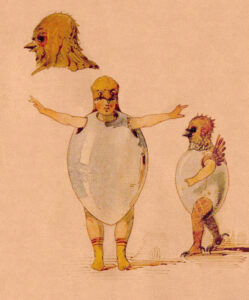
5. Ballet of the Unhatched Chicks – According to Stasov, “In 1870 Hartmann designed the costumes for the staging of the ballet Trilbi at the Maryinsky Theatre, St. Petersburg. In the cast were a number of boy and girl pupils from the theatre school arrayed as canaries. Others were dressed up as eggs.” Once again, Mussorgsky’s affinity for children shines through this bright and energetic depiction.
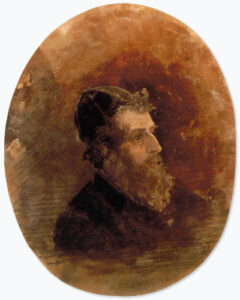
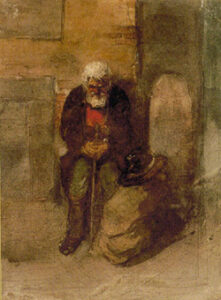
6. Samuel Goldenberg and Schmuyle – Much confusion and controversy has surrounded the name of this movement, due in large part to the subtitle Stasov added for the first published edition, Two Jews, Rich and Poor. An examination of the manuscript reveals that Mussorgsky did not use Stasov’s subtitle, but did indeed use the personal names of the two subjects. These names do not appear in the catalogue of Hartmann’s exhibit, however, and were likely created by the composer. Regardless of the title, the artwork and music both vividly portray members of two very different elements of society.
7. Limoges. The Market Place (Important News) – The artwork that inspired this movement is lost, although it was probably one or more of the seventy-five images of Limoges that were included in the exhibit. According to Stasov, “Hartmann spent a fairly long time in the French town in 1866, executing many architectural sketches and genre pictures. The musical version of this sketch [illustrates] the crowd shrieking, disputing, chattering and quarreling in the marketplace.”
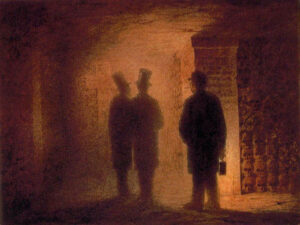
8. Catacombs (A Roman Sepulchre) – With the Dead in a Dead Language – Hartmann’s portrayal of the Parisian catacombs, one of the collection’s most evocative and personal images, has survived. It depicts the artist himself, along with a friend and their guide, as they are about to tour the catacombs by lamplight. To the right of the entrance is a large case of skulls glowing in the darkness, a detail that attracted Mussorgsky’s attention. In the margins of the manuscript he penciled the subtitle of this movement in Latin, commenting that “Latin text would be fine: the creative genius of the late Hartmann leads me to the skulls and invokes them; the skulls begin to glow.” As the Promenade theme emerges from these haunting chords, it suggests that in his imagination the composer has joined the artist in his nocturnal tour through the catacombs.
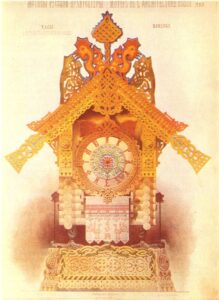
9. The Hut on Hen’s Legs (Baba-Yaga) – According to Stasov, “This piece is based on Hartmann’s design for a clock in the form of Baba-Yaga’s hut on hen’s legs, to which Mussorgsky added the ride of the witch in her mortar.” Mussorgsky scholar Michael Russ amplifies Stasov’s description: “Baba-Yaga appears in Russian fairy-tales. She lives deep in the woods in a hut whose hen’s legs allow it to rotate to face each unfortunate newcomer. There she lures lost children to eat them, crushing their bones in the giant mortar in which she rides through the woods, propelling herself with the pestle and covering her tracks with a broomstick.”
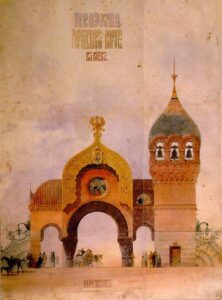
10. The Great Gate of Kiev – Stasov informs us that the gate that inspired this movement, designed by Hartmann for a competition at Kiev, was done in the “massive old Russian style, with a cupola in the form of a Slavonic helmet.” Although the goal of the competition was to identify a design for a new gate to be constructed in commemoration of Tsar Alexander I’s escape from an assassination attempt in 1866, the construction of the gate was cancelled. Regardless, Hartmann’s design attracted considerable attention, and he regarded it as one of his greatest accomplishments. Much like Mussorgsky’s music, it is thoroughly nationalistic in design, incorporating Russian elements such as the eagle, cupola, ancient Russian figures, and the old Slavonic inscription: “Blessed is he that cometh in the name of the Lord.” The composer mirrors the intent of the artist through the use of a Russian Orthodox chant as well as recurring bell motives that evoke the pealing of multiple carillons for a climax that is one of the most memorable in all classical music.
It is highly unlikely that there is another piece of classical music that has been arranged, transcribed, or adapted more often than Mussorgsky’s Pictures at an Exhibition. In the decades since it was published for solo piano in 1874, it has been re-imagined for an incredibly wide range of ensembles, including chamber orchestra, symphony orchestra, wind ensemble, concert band, jazz orchestra, brass ensemble, percussion ensemble, vocal ensemble, piano duet, piano trio, solo organ, organ trio, solo guitar, and synthesizer, as well as progressive rock, metal, and punk-jazz bands. When one tallies the published versions of these settings, the count exceeds sixty-five, and when the unofficial arrangements and incomplete settings are included the number easily surpasses one hundred! In spite of this deluge of transcriptions, however, there is only one whose fame and success rivals that of the composition itself: Maurice Ravel’s incomparable setting for symphony orchestra.
Notes by Colonel Michael Colburn, “The President’s Own” United States Marine Band
—-
My interest in orchestrating Pictures developed from requests from members of The Lafayette College Concert Band: several members of the ensemble had expressed an interest in attempting the work, and as one of my goals is to program good orchestral transcriptions (so that the students have the experience of studying this repertoire–there is as of this writing only a string orchestra at Lafayette), this seemed like a good fit. I immediately began a search for existing orchestrations for wind ensemble, but found none that precisely matched my pedagogical goals. Specifically, I wanted an orchestration that retained Ravel’s major solos (saxophone, trumpet, euphonium), but did not simply transcribe Ravel’s orchestration for winds. The orchestration therefore had to make the most and best use of the sonic possibilities of the wind ensemble medium. No such orchestration existed, and therefore, after some deliberation I decided to undertake the project myself.
I decided early on to not to try to re-invent the wheel with this project. Instead, I chose to work from Mussorgsky’s score in consultation with Ravel’s to create sounds that would be recognizable but not identical to Ravel’s. I wanted the audiences that heard my orchestration to hear something new in the piece that would allow them to hear more the next time they heard Ravel’s orchestration. In that sense, I hoped to compliment Ravel, and not replace him.
As a result, there are moments in the score which do use Ravel’s instrumentation (particularly in places like the first quiet section of The Great Gate of Kiev). As I mentioned above, I used the same instruments Ravel used for the major solos. There are a few major differences, however. To begin, I added the Promenade that Ravel cut, scoring it for brass and timpani. Additionally, I use the percussion section more than Ravel did, relying on mallet instruments to create (or enhance) tremolo effects that are not idiomatic for winds. Finally, I treated the orchestration as a kind of Concerto for Wind Ensemble, in a manner similar to how Bartok treated the orchestra in his Concerto for Orchestra: the three choirs (and soloists within these choirs) are featured more or less equally at different points in the piece. I tried to contrast the large tutti sections (as in Gnomus, Baba Yaga, or The Great Gate of Kiev) with small chamber ensembles (as in Tuileries, or Limoges). In addition, I removed Ravel’s rehearsal numbers and replaced them with rehearsal letters that more closely illustrate the forms of the individual movements. The result is an orchestration that is not far from Ravel but not identical either.
Notes by Kirk O’Riordan
From the Conductor
Thank you very much for joining us tonight, and for supporting the students, faculty, and staff of the Lafayette College Department of Music.
There is a lot of fun music on this program. A range of moods, textures, colors, sounds….certainly difficult technical challenges, moments of high energy and moments of quiet reflection. It is a long program which tests the endurance of our players, especially the brass. Let us also not forget how well-known these pieces are–a factor that provides a different kind of pressure.
Approaching and confronting all of that is what we in LCCB consider “fun.” We value the growth and bonding that come from shared challenge. We believe that our potential vastly exceeds our actual, and that the distance traveled from point A to point B is more important than where point B is. We believe that we are stronger together than we are apart, and that despite differences in skill and experience, each individual is indispensable and a crucial part of the whole. We are a community, and our responsibilities to each other motivate individual accountability.
This–and a lot of hard work in rehearsals–allow these students to approach music like this. But more importantly, they develop the intangible skills that will lead to success after their time at Lafayette ends.
Assuming of course, that it does end…because for a good number of our performers tonight, it really hasn’t. We have a motto: “There’s always a chair for you.” Tonight, no fewer than eight alumni will be returning to perform with the current students. Two of them are performing their 16th concert with LCCB, bringing the number of former students in the LCCB16 club to four.
Every 16th concert is special…but tonight Peter Rice ’84 and Katie Rice ’21 share the evening. I am not able to adequately convey how important and impactful the Rice family has been to LCCB and to me personally.
The Lafayette College Concert Band
Assistant Conductors
William Hoelzel
Madeline Paguia
—–
Flute
Brian Morris, Principal
Emily Kozero
Emma Martin
Owen Rudolph
Julia Campbell Anderson
Iris Peluso
Jamie Lin, piccolo
Oboe
Kaia Frazier
Clarinet
Aram Ramsay, Principal
David Broczkowski
Emily Rice
Priscilla Wu
Benjamin Alter
Lily Hooghuis
Ashley Kushner-Kmetz
Kaitlin Brill
Christopher Ruebeck
Jennifer Blair
Bass Clarinet
Peter Rice
Contrabass Clarinet
Ashley Golden
Bassoon
Katie Rice
Peri Chain
Saxophone
Julia Sealing, Principal (alto)
Andrew Manni (alto)
Madeline Metzger (alto)
Cassidy Baisley (alto)
Alex Kmetz (alto)
Evan Brown (tenor)
Elisa Massa (baritone)
Horn
Madeline Paguia, Principal
Mariella Morales
Anastasia Krial-Victor
Nicholas Pignolo
Trumpet
Corey Stein
Kaylee Williams
William Blair, Principal
Robert Leiter
Mason Quintard
Charlotte Konopada
Trombone
Pedro dos Santos, Principal
Jackson Eshbaugh
Jasmine Smith
Nolan Sirgany
Bass Trombone
Benjamin Zwicker
Euphonium
Andrew Bauer
Tuba
Jack Kerekes
Mikayla Tanzos
Nick Sears
Piano
Ian Moschenross
Percussion
Will Hoelzel, Principal
Casey Alexander
Joe Freeston
Noam Raich
Henry Schrader
Gabe Sack
Grace Farah
William Nicoll
Graduating Seniors
Lafayette Faculty/Staff
LCCB Alumni
Guest Performers
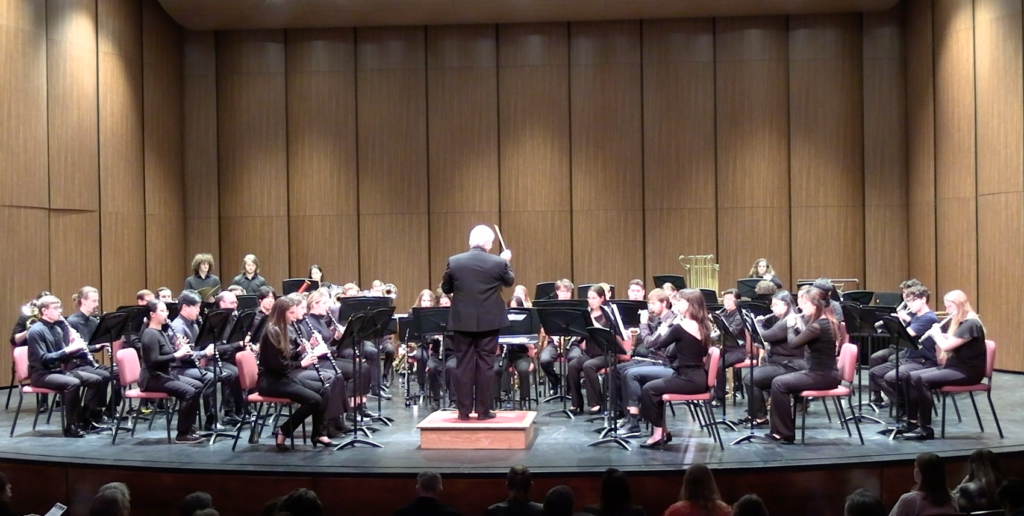 The Lafayette College Concert Band is comprised of approximately 50 students, faculty and alumni from a variety of majors who are united by a strong desire to perform the highest quality music at the height of their abilities. Participation in LCCB is open to students in any major as well as faculty and staff. The ensemble is conducted by Kirk O’Riordan, Director of Bands and Associate Professor of Music.
LCCB typically performs one concert each semester. The repertoire is selected from traditional concert band masterpieces, newer works by established and emerging composers, commissions, and orchestral transcriptions. Past concerts have included works such as Husa’s Music for Prague 1968, Bernstein’s Symphonic Dances from West Side Story, both Holst Suites, Grainger’s Lincolnshire Posy, and Mussorgsky’s Pictures at an Exhibition. LCCB has premiered works by composer/conductor Kirk O’Riordan and 2010 Pesky Artist in Residence William Pfaff as well as Ashley Kushner ’19 and Zach Jones ’13.
Students enroll for 1/4-credit. Open to all students, faculty and staff, LCCB employs a wind ensemble model for instrumentation. A seating audition is required before the first semester of participation. Due to the large numbers of flutists, clarinetists, saxophonists, and trumpeters, the number of available seats in these sections may be limited.
 Several opportunities for leadership in the ensemble are available for highly motivated, experienced players. Principals in each section lead sectional rehearsals and help the less experienced players with technical issues. The Assistant Conductor is a highly advanced musician who has been studying conducting for at least one year prior to serving in the position. She/he conducts the ensemble on at least one piece in performance, having led all the rehearsals for that performance. Typically, that person also leads Pep Band and conducts the annual Marquis Players musical production. Finally, the LCCB President is nominated and elected by the student membership of the ensemble. This person works with the director and the Assistant Conductor on administrative tasks as a representative of the students.
Blurred Days CD
 Like many bands and other performing ensembles across the country, we have had to adapt to the pandemic. For us, this has meant that we have not been able to work together, in person. This has always been a band that thrives on its sense of community, and not having that has been hard on all of us.
But rather than mourn what we have lost, we have searched for opportunities within our remote format that are unique. Working in isolation has allowed us to re-examine the possibilities of the Wind Ensemble as an entity—to re-imagine what is possible with this collection of sounds.
The five pieces on this CD were written especially for us, and especially for our situation. Each of the pieces was conceived to take advantage of techniques that would not be possible in a traditional concert—effects on a person-by-person level, or writing for flutes in their lowest register.
To make these performances, each student recorded his or her part on their phones or computers and uploaded them to either a shared drive or to the web-based recording service Band Lab. Katie Rice assembled the tracks and performed the first round of editing. I took the tracks she finished and combined them into the final product, completing the pre-production audio work.
Every student has a unique track in the recording, which allows us to use studio effects on a person-by-person level. With many of the pieces, the individual parts were created to be non-linear—we could create specific sonic effects and duplicate them in the recording software. Several of the pieces incorporate improvisation, narration, and other unconventional techniques.
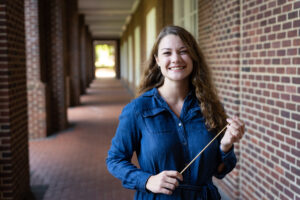
Katie Rice ’21, Guest Conductor
Kirk O’Riordan, Conductor
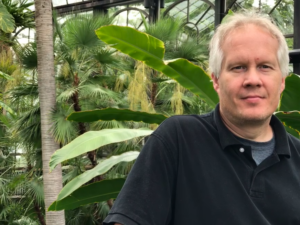 Kirk O’Riordan’s music has been referred to as “unapologetically beautiful” and is often praised for its uniquely “visual” qualities that depict a wide range of striking moods. His debut compact disk, Strange Flowers, was released by Ravello Records in November, 2013 and was praised by Audiophile Audition as “one of the most impressive and beautiful collections of chamber music I have heard in awhile….This is all just so lovely and invokes exactly the emotions that good music should be able to induce in all of us.” Gramophone Magazine praised O’Riordan as “a composer for whom imagery is a defining inspiration….[he] is a deeply sensitive composer who savours going gently into the night.” (April 2014).
His recording of his Twenty-Six Preludes for Solo Piano—by pianist Holly Roadfeldt—has attracted similar praise: “are similarly atmospheric and proceed to unfold like a magical tapestry. Each of the 26 Preludes seemingly comprising of warp and weft forming a myriad of pixels of little pictures that ultimately combines to form a moveable feast for both eye and inner ear. O’Riordan’s miniatures are informed by languorous beauty and profundity, the lyrical variations of each often feature elaborate embellishments, as well as sudden dissonant figurations that seem to mimic the gravity-defying leaps of the gazelle…” (World Music Report, April 2017).
O’Riordan (b. 1968) is an active composer, conductor, saxophonist, and teacher. His music has been performed in Canada, China, Costa Rica, Cyprus, Finland, Italy, and Russia; and in thirty of the fifty United States. Performances of his works have been featured at the Ravenna Festival (Italy), the Indiana State University, University of North Carolina, Greensboro and Western Illinois New Music Festivals, the 2008 Eugene Rousseau Birthday Celebration, national and regional conferences of the Society of Composers, Inc. and the College Music Society; and in concert by such performers as the Eaken Piano Trio, Tresillo, The Moran Woodwind Quintet, Orchestra Bruno Maderna (Italy), the Arizona State University Chamber Winds and Symphony Orchestra, the Northwestern University Contemporary Music Ensemble, the Cleveland State University Orchestra, the University of Colorado Chamber Wind Ensemble, the University of Delaware University Singers, the Williamsport Chamber Chorus and Orchestra, the Susquehanna University Orchestra and Chamber Singers, The Lafayette College Concert Band, Contemporary Music Ensemble, and Percussion Ensemble, the SKIN Ensemble, Frederick Hemke, Timothy McAllister, Lawrence Stomberg, Marianne Gythfeldt, Kenneth Tse, Jeffrey Lyman, Emily Bullock, Steven Stusek, Andrew Rammon, Reuben Councill, John Perrine, and Holly Roadfeldt.
Kirk is the recipient of numerous awards as both a composer and a performer, including annual ASCAPlus awards, a Composer’s Assistance Program grant from the American Music Center, the 2001 Arizona State University Composition Competition, the 2000 Contemporary Music Society competition, and an ERM-Media Masterworks Prize. In addition, his Cadenza for Piano Trio was one of two works selected by audience members at the CMS Mid-Atlantic/Northeast Super-regional Conference for performance at the 2008 CMS National Conference.
Kirk’s music has been broadcast on WSMR, KBAQ, WQSU, and WVIA radio. Recordings of his works appear on the Crystal Records, Ravello, Centaur, ERM-Media and EnF labels, and feature performances by Kenneth Tse, Lawrence Stomberg, Marianne Gythfeldt, Holly Roadfeldt, Frederick L. Hemke, The Kiev Philharmonic, and Farrell Vernon. He has recently received commissions from AVIDduo, Saxton Rose, and Holly Roadfeldt. He recently completed his first opera: The Masque of Edgar Allan Poe, a one-act chamber opera based on Poe’s “Masque of the Red Death” on a libretto by Lafayette College colleague Lee Upton. The work was premiered by the University of Delaware Opera Theater in November, 2016 and subsequently at Lafayette College. Other projects have focused on music for dance: his River Lights for Orchestra (as recorded by the Kiev Philharmonic) was used by dancer/choreographer Ben Munisteri in his piece, Robot vs. Mermaid. O’Riordan has also collaborated with dancer/choreographers Carrie Rohman and Nandini Sikand. Recent projects include a concerto for Taiko Ensemble and Concert Band (for the Lafayette College Percussion Ensemble and Concert Band), incidental music for a Lafayette College Department of Theater production of Mary Zimmerman’s play Metamorphosis, and a new work for viola and piano for violist Michael Hall and pianist Holly Roadfeldt.
Dr. O’Riordan joined the faculty of Lafayette College in 2009, and now serves as Associate Professor of Music and Director of Bands, teaching courses in music theory, and composition. In addition, he teaches in the First-year Seminar program and conducts the Lafayette College Concert Band and Contemporary Music Ensemble. During his time at Lafayette, the Concert Band has been hailed for its ambitious and adventurous programming, having performed works such as Husa’s Music for Prague 1968, his own orchestration of Pictures at an Exhibition, and world premieres by O’Riordan, Ashley Kushner, Justin Kogasaka, Zach Jones, Pete Deshler, and William Pfaff. Previously, he served on the faculties of Bucknell University and Susquehanna University where he taught music theory, composition, music appreciation, and (English) writing. He has also served on the faculties of Lock Haven University, Colorado Christian University, Chandler-Gilbert Community College, and Paradise Valley Community College. He holds the Doctor of Musical Arts degree from Arizona State University (the first recipient of that degree from ASU); the Certificate of Performance in Saxophone from Northwestern University; and three Master of Music degrees (composition, saxophone performance, and conducting).
Kirk has studied composition with Rodney Rogers, Randall Shinn, James De Mars, Glenn Hackbarth, Jay Alan Yim, Burton Beerman, Marilyn Shrude, and Donald M. Wilson. He has studied saxophone with Frederick L. Hemke, John Sampen, Eugene Rousseau, and Iwan Roth. In his free time, Kirk is an avid fan of Obstacle Course Racing.