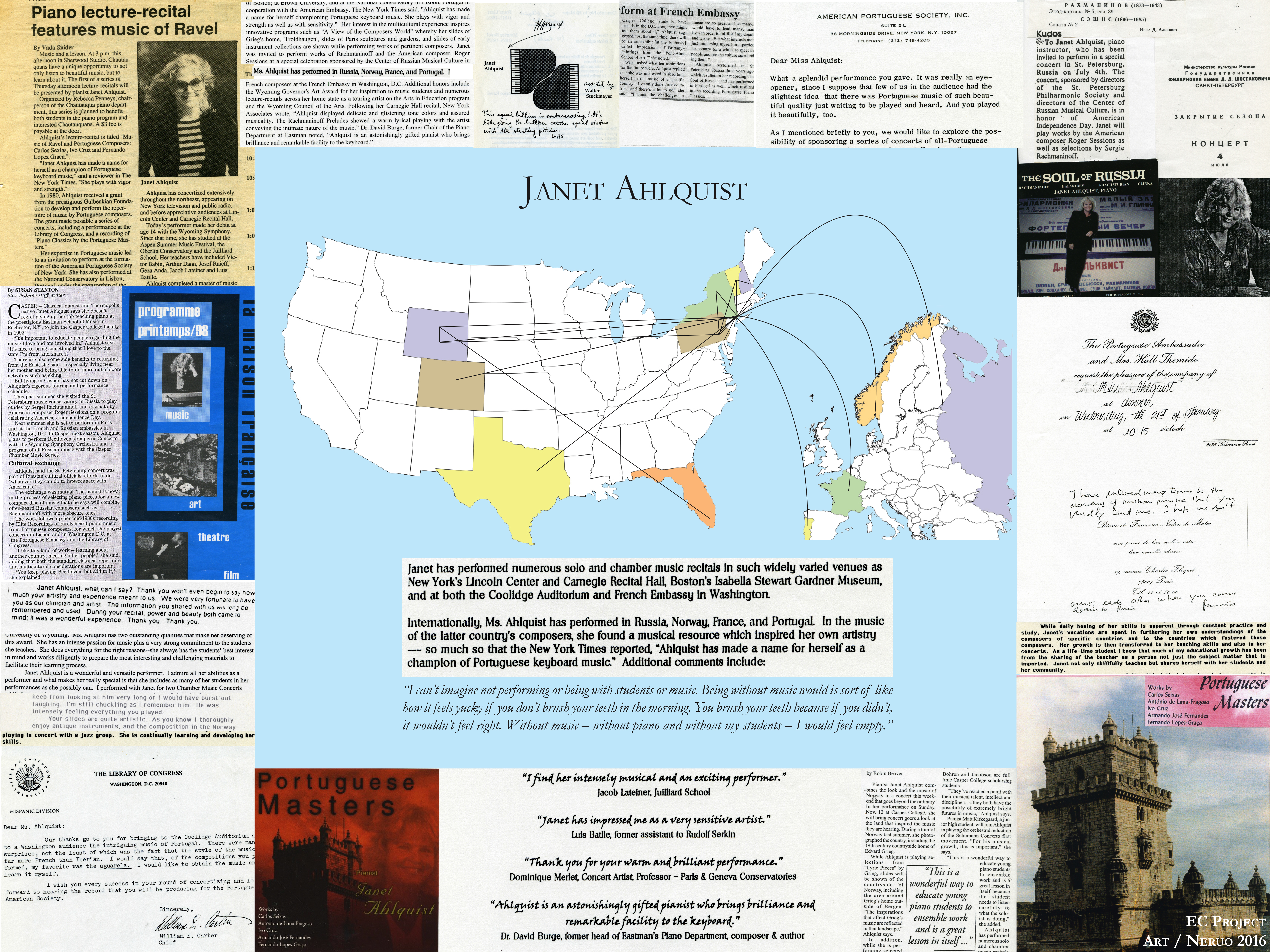
Ryan + Alex – EC Infographic Draft – Janet Ahlquist
Leave a reply
Stacy Nganga and Mirielle Vasselli
QUESTIONS AND ANSWERS:
| Topic | Question |
| Development | Where were you born?
Thermopolis, Wyoming No it was very rural. |
| What was your childhood like?
It was very free spirited, lots of play, education wasn’t too focused – they still don’t have a string program there. But you weren’t locked into a square-box pressure cooker of going from activity to activity because, well, there wasn’t much. Drove once a month for piano lessons 130 miles away. Her parents made the trip “ritually” |
|
| What was your socio-economic situation? | |
| When did your passion for X develop?
Never thought of it as a profession, never occurred that she would live without music as part of her life. |
|
| Were your parents active in your pursuit of education/activities?
Yes. At first took lessons in the town. Later parents drove 2-3 hours each way to lessons once a month Absolutely, spent time in Denver with her mother to take lessons with a prominent teacher. During college, drove her to school and were glad that she was at a good place to learn. Father liked it when she was in the newspaper |
|
| Did you have a mentor?
Woman in Casper 130 miles away. Brenda Layman(?) went to royal music academy in London. She got her the first concerto to play at. Amber Concerto. Definitely inspiration, allowed her to get good enough to go to Oberlin. |
|
| What was the moral authority when you were growing up? [religion] | |
| During your development, how did you compare against other practitioners [at your level?]
She didn’t compare. She just played to see what happens and often won. She also didn’t have too many similar-minded pianists around (she works with classical music). |
|
| Did/do your parents do something related to your craft?
Her father played clarinet in a band, but without formal lessons. He clearly had a natural knack for music – he could play almost any piece by ear. But he never learned to read music. |
|
| Craft | What emotions do you associate with your craft?
Couldn’t find this |
| When did you find things came naturally to you?
Mentor at Juliard told her it would be nice when she got her feet on the ground – so she never really thought about when things were hard, easy, just was doing her thing and turned out this way. N/A |
|
| What is the biggest obstacle for your practice?
3mo pregnant, went to an event in Texas. Morning sickness all day, still determined to play. Performance wasn’t too good, went straight back to NY, have had performance anxiety issues to deal with ever since. |
|
| Were there any costs/sacrifices to pursuing your passion?
A great deal because of having young children to raise, so yes. |
|
| Expertise | What qualities do you associate with expertise in your field?
Ability to listen well and distinguish between tone quality and musical phrasing and effect of a particular piece of music. Inherent in this is so much more than reading the notes. Didn’t understand her answer but I kinda zoned here. |
| How long have you been working in your field?
I wasn’t always a solely serious musician. I was seriously being president of a nursing school for awhile. I was seriously involved on the pediatric floor. Life hasn’t been a direct route in any way whatsoever. It’s been like they describe the artists journey: a winding path. |
|
| What was the evolution/changes in your practice?
She approaches music in a different way now than in the past. Since the performance blunder in TX, “I require myself to be able to mentally play a piece entirely in my head – not even using my fingers – all 45 minutes of it. Being able to do that, it means I know every key area, every note – that internal map that’s embedded in me. It’s very different, because I trusted myself before. When you can no longer trust something, you have to find another way to go on, otherwise you have no choice but to stop.” |
|
| When did you realize you were an expert? You had achieved mastery? If I didn’t have [mastery of interpretation and understanding of the music ] I don’t think I would do it because it wouldn’t be meaningful to me. I wouldn’t care if I just had something technically fine – it would be pretty boring to me. You might as well just play scales. |
|
| Are there any limitation in your field? How do you get around them? | |
| When did you experience a breakthrough moment?
Never pursued something specific, knew that after touring she wouldn’t pursue getting a manager for future touring, she knew she wanted to teach. |
|
| Motivation | Do you ever feel burned out? What motivates you to keep practicing?
What motivates you?: Certainly if there is a performance or responsibility/obligation. Aside from that, “I can’t imagine not performing or being with students or music. Being without music would is sort of like how it feels yucky if you don’t brush your teeth in the morning. You brush your teeth because if you didn’t, it wouldn’t feel right. Without music – without piano and without my students – I would feel empty.” |
| Do you have any regrets?
Absolutely. In the past she knew nothing compared to now, there are things she would do differently. She wouldn’t have had that flop at the competition, she would have still had her child, but not as bad of an experience in TX. |
|
| Presently | What have you learned from being a mentor?
“I’m always rethinking things and learning from my students. Indeed there are many layers of learning, and there are so many layers to music that it would take lifetimes to explore them all.” |
| How do you stay fresh? Do you collaborate with younger practitioners?
Yes she has her own students. See above. |
|
| Which project of yours is your favorite?
No favorite, they all become favorites. |
|
| Which project is considered your best?
Can’t really give much consideration for what the public thinks. When it’s another pianist that complements that means so much more. The public in general doesn’t appreciate quite on the same level though. |
SCANS: (out of space on the server)