Time worked differently when I was in college. While the calendar flew by quickly, there was a stronger density to time. Days could feel as big as weeks; weeks could feel like months with all that they held. Never was that more true than when I went on my study abroad semester in the UK with a group from my college as a junior. Each day somehow held a lifetime.
Despite teaching at colleges and universities for over half my life now, I’ve settled into “adult time”: the days come, the days go, the weeks and weekends always end too quickly, but there’s a certain evenness to things. This semester, I find myself back in that odd cosmic mystery of “study abroad time,” where it’s hard to believe on a Thursday that what I experienced on the previous Monday wasn’t actually a memory from a month ago—or yesterday. It’s an exciting, heady feeling, euphoric and exhausting. And it makes processing harder than usual.
My family and I have now been in London for four weeks now; my stu
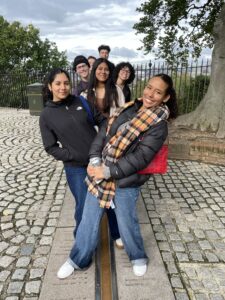
We’re so on top of Greenwich Time here at the Prime Meridian!
dents have been here for nearly two. Classes started for them at Goldsmiths this week, while our course started last week, amid a flurry of readings, excursions, and figuring out Lafayette technology vis-à-vis various British systems. A lot of time has passed without a post here, so I’m going to talk a bit about time.
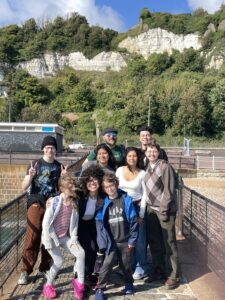
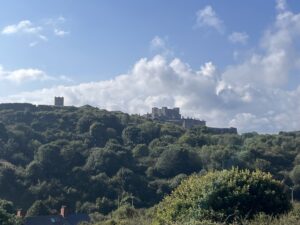
One of the biggest things that has struck us as a group so far is the layeredness of Britain. On our trip to Dover, we got lunch in a strip mall dominated by a centuries-old castle on the ridge behind it. This week, we rode the Thames River Bus, where I saw the ultra-modern landmark The Shard framed between the iconic pillars of Tower Bridge. We’ve walked Hampstead Heath, where old trees and meadows left open for centuries have bespoke, modernist houses nestled behind them.
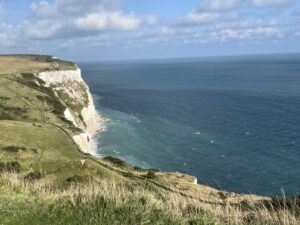
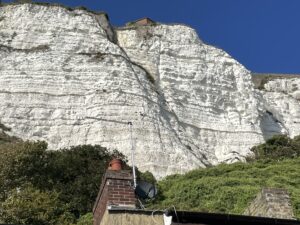
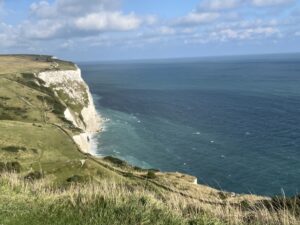
Monumental icon, or extreme slow-motion movie? The Cliffs of Dover are gorgeous, but a bit of a mystery.
Even the Cliffs of Dover themselves are a testament to layering, formed by the accretion of billions of tiny skeletons on a seabed that now is as high above the Atlantic as College Hill is above Easton back home. And that layering is eroding back into the seabed now.
One of our first readings for our course is from A Land, a book by archeologist-geologist Jacquetta Hawkes, published in a post-World War II climate in which London was still littered with uncleared bomb sites and a new wave of industrialization and suburbanization was about to sweep away far too much of Britain’s remaining biodiversity. Hawkes makes things personal from the start, describing the feeling of lying on her back in her garden and gazing up at the stars, the night sounds of West London floating around her—huge systems envelop her, but she feels it all strongly and in the small, unique space of herself.
Hawkes is a master of moving between intimate, first-person “I” narration and the grand sweep of geological and ecological time. She can go from bedrock to the window box and back again, and always with a sense of how dynamic, how in-process it all is. As much as the bends of the Thames and the roll of the Chalk Downs seem eternal to us, these are all very brief moments for our planet.
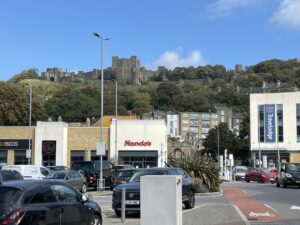
Lunch in a strip mall with a castle behind it. Because England.
Another of our authors, Amy-Jane Beer, puts it this way in “What Is a River?”: “A river is water’s very occasional chance to flicker and dance under the sun before it returns to the deep, dark ocean, is frozen in ice or stores away underground.” Everything we see has a history. It’s also in history, right now. T. S. Eliot’s gnomic statement in “Little Gidding” takes on new meaning with this kind of vision: “History is now and England.”
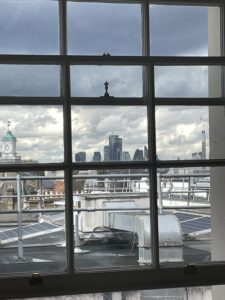
Yesterday, while exploring the Royal Museums at Greenwich, we stared out across the Thames at the Docklands skyline, one that hardly existed the last time I stood in that place twenty years ago. After human migration around London has tended westward for nearly two millennia, the center of the city’s gravity finally seems to be moving east again. The island of Britain is sliding into the Atlantic in the same direction, a few millimeters a year, and London itself is sinking through its clay toward the gravel layer below.
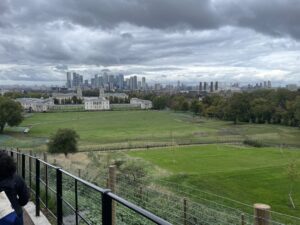
The Docklands skyline from Observatory Hill in Greenwich. None of this was considered London until rather recently.
These impossibly huge, gradual, inexorable processes are happening right in front of us, even as we’re soaking up so much time in a Greenwich afternoon that we can’t catch up to it. Our smallness in all of this is humbling and exciting. It also offers us a pointed question: how do we notice and respond to this world where so much is happening, in our writing and other kinds of living?