Data Collection:
As it stands now, a “heavy day” of passengers on the LCAT to Metzgar is about 12 students, per Keith Zweifel, Metzgar route driver for the past two years. (Zweifel, 2023) Considering this route runs from the hours 3pm to 9pm, that’s only 2 passengers an hour. The loop to Metzgar, the Intramural fields, and back to campus takes about 35 minutes round trip. With this in mind, that comes out to about one passenger per loop (LCAT, 2023). Not only is this unsustainable, but teeters the line of wasteful. Per Sandra Rogers, the riders along the Metzgar route totals to 297. Notably, the total ridership of the shuttle throughout campus is 2,450. The other three LCAT routes, Weekday Community Involvement shuttle, Saturday shuttle, and Arts Campus shuttle, account for 1,472 minutes of travel each week.
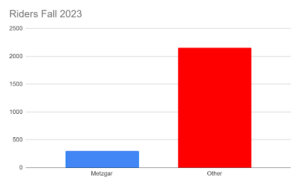
Figure 3.1. Total Riders Fall 2023
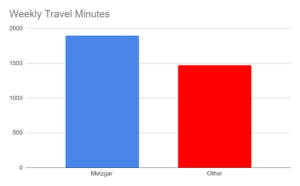
Figure 3.2. Weekly Travel Minutes
The Metzgar route accounts for 1,900 minutes of travel per week. Considering that the Metzgar route is responsible for over 56% of travel time per week, the fact that it only accounts for about 12% of the campus wide ridership is cause for concern. If the LCAT is proving to be unsustainable on its heaviest days, then changes are pertinent.
The Problem:
The disproportionate amount of riders compared to travel time leads us to the question of why don’t students opt to use the LCAT when traveling to Metzgar. Based on our survey results, we came to the conclusion that not enough people are aware of the LCAT Metzgar route and that the current route doesn’t serve the students conveniently enough. As it stands now, the pickup spot on campus is on the corner of Hamilton and Pierce. We see this as problematic because it is quite far from both classes and housing. The original thought behind designating this corner as the pick up spot was that it is right outside Kirby Sports Center. It was perceived that athletes would be around the building and could catch their ride to practice right outside. The reality is student-athletes within sports that travel to Metzgar are not commonly in Kirby Sports Center. In order to get more familiar with the system, we decided it was best to take the shuttle. Even on our first journey, it was apparent how “out of the way” the Hamilton and Pierce pick-up spot was. For an ‘on-campus’ pick-up location, it was more on the outskirts. Perhaps even worse, was the drop-off at the same location. After a long day of class and practice, student-athletes are likely reluctant to walk up the hill and across campus to get to their housing or even dining halls. In fact, the two dining halls open past 6 o’clock, Marquis and Farinon, are about a 2,600 and 1,600 foot walk, respectively (See Figures 4.1 & 4.2). That means that student athletes that are going to dinner after practice have to walk either half a mile or half a kilometer.
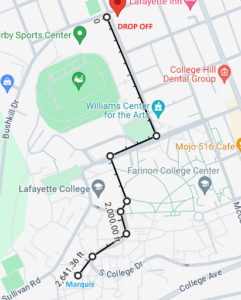
Figure 4.1. Drop-off to Marquis
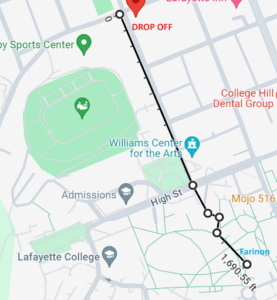
Figure 4.2. Drop-off to Farinon
Student Survey Results:
Following our own LCAT excursions, we sought feedback from other students. We, then, launched a survey where we recorded 55 responses from student-athletes. Our two initial questions were as follows in the charts below:
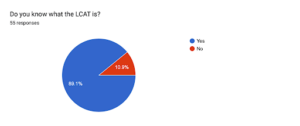
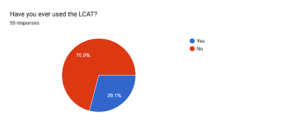
Figure 5. Survey Results
Although 90% of the surveyed students knew of the LCAT, only 30% had ever used the shuttle. Even of this 30% (19 students) only 6 of them used the shuttle to Metzgar. When asked what would make the LCAT more appealing to take, nearly half of the responses were concerning the schedule and route, with pick-up and drop-off locations being a main focus. Using this feedback, we began exploring options of an updated route, adjusted to meet the needs of student-athletes and the college community as a whole.
Solution #1: Change Route & Pick-up spots
When building towards a solution, we had to first establish a target audience. Through discussion with Andrew Foster of the Athletic Department, it was clear that the primary population this specific shuttle aims to serve is student athletes. More specifically, it was student athletes whose sport is located at Metzgar Fields. Understanding that Lafayette College has an academic time designation of 8am-4pm, practice and competitions are more than usually after 4pm. This is reflected in the shuttle’s time table, where it begins at 3:30pm. With this in mind, it is common for student-athletes who travel to Metzgar stack their mornings and afternoons with classes in order to not interfere with practice times. From this, it is more likely that these student-athletes are going straight from their classes to Metzgar Fields. Considering this, we believe a route that runs through South College Drive and passes many of the class buildings and housing buildings would attract more riders. Our proposed route adjustments are shown in Figure 6.
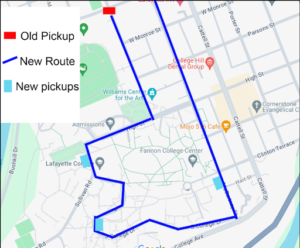
Figure 6. Proposed Shuttle Route
Solution #2: Enhanced Marketing of the LCAT and RideSystems App
On the other hand, we found many of the student-athletes who may benefit from the LCAT Metzgar route are just simply not aware of it. When it comes to advertisements of the LCAT, we have not seen any in our own four years at Lafayette College. We knew this was an issue and we went through a long progression of solution ideas. With keeping better marketing at the forefront of our concept generation, we first came up with the idea of a new Lafayette College run app. We wanted this app to have the routes, pick up locations, live trackers of the shuttle, notifications and times incorporated in a way that makes the user experience very easy and accessible. We essentially envisioned students being able to access the app and go through a pain free process of catching a ride to Metzger. We also thought that the app could be a huge marketing tool for Metzger sporting events. We pictured all student athlete competitions being promoted through the app. For example, students could receive a notification saying that there is a women’s soccer game happening at 6pm, they then would be promoted with pick up locations, times, and routes to make the trip to and back from Metzger. This aspect held true to our concept of better marketing for the LCAT itself and student athlete competitions. From discussions we’ve had with Public Safety and the Athletic Department, it was revealed that the only advertisement of the LCAT is done during Orientation. We envisioned the app being downloaded by all students at orientation would help this initial promotion not go to waste. The students could become aware of its benefits from the very start of their Lafayette College journey and would not have a simple word of mouth promotion go in one ear and out the other. With this, we recognized that marketing of the app and system itself would still need to take place past freshman orientation. The word of mouth presentation of the system has shown not to be effective as from our data we found that only 30% of student athletes surveyed have used the LCAT, with 10% not even knowing what it is.
As our concept generation progressed, we found that there is an existing national app called Ride Systems. The app is very popular among colleges, specifically ones similar in size to Lafayette. While the app doesn’t have everything we envisioned, we found that it does have some great aspects (See figure 7).
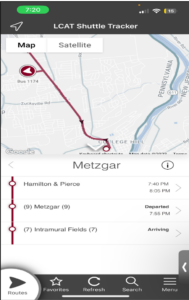
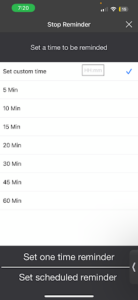
Figure 7. Ride Systems Display Example
Not only does the app provide a live tracking visual of the bus with corresponding time estimations, but it allows the user to be reminded with a notification. The app could drastically change how students interact with the LCAT and the fact that the app isn’t easily discoverable is problematic. Also, the app is not owned by Lafayette College and the LCAT is not a major focus within the app as it displays many bus routes. The app is a significantly attractive aspect to the LCAT, yet it’s rendered almost useless because people are not aware of it.
After going through this progression, we realized that the root of the problem comes down to marketing of the current app and of the system itself. Our proposal is to increase LCAT advertisement within different avenues that would effectively connect students with the LCAT, essentially giving the system a marketing makeover. Of these avenues, we see three key implementations that are very attainable.
First off, coaching promotion. We see a lack of formal and informal promotion of the system through coaches of sports teams at Metzger. This has been shown by student athlete interviews and surveys. We propose coaches promoting the system in a formal way at the beginning of the year. This will have to be stressed from athletic administrators to make sure it gets done. Through our experience, teams normally have a meeting at the beginning of the year that pertains to the logistics of the season. These meetings normally have many non sports related topics presented, such as tutoring resources and food options on campus. We believe that if the LCAT is promoted by coaches in this type of meeting, it could greatly help student athletes become more aware of the system. We also would like to see coaches promote the system in more informal methods throughout the year. We believe aspects as simple as reminding players this is a viable option would help ridership. Many student athletes get weekly practice and game schedules sent out to them every week. We envision that the LCAT schedules and times can easily be added to these schedules to further help promote the system.
Our second key aspect involves marketing through social media. Every team and GoLeopards social media account markets their games through social media. We believe if students were presented with the ease of transportation through these same posts, it could significantly increase attendance to Metzger sporting events. This would be done by simply adding pick up locations and times to the game promotion graphics. We envision students being presented with the ease of transportation to these events, making it worth it for them to attend. We hope to limit convenience issues such as not having a car, not wanting to drive, or unreliable pick up times. This solution works hand in hand with our adjusted pick up locations and times presented earlier. By adding flexibility for the shuttle service to travel to sporting competitions outside of its regular schedule, this marketing approach could be implemented.
Our final idea suggests more marketing and promotion from the college itself. We would like to see the existing app promoted in an informal and formal manner, starting from freshman orientation. Through survey results we found that many students have never heard of the existing app. We assume that better promotion of this app from the beginning of students’ careers will vastly improve LCAT ridership, due to the positive user experience the app provides. During our meeting with Jeff Troxel and Sandra Rogers, they mentioned how years ago they attempted to include the LCAT in their ‘Stool Talks.’ Stool Talks reference the info-boards that are on the inside of stall doors in college owned bathrooms. A short, informative message along with QR codes for the Ride Systems app and time table could have a modest impact for such a small solution. We think this being revitalized could greatly help the system’s promotion, along with other forms of infographic marketing.