Financial Structure
The financial structure of the LCAT is quite complicated which has made it difficult for us to get our hands on concrete data. First, it is important to understand how the system works. Lafayette College has a contract with Easton Coach, who provides the drivers and the bus. Public Safety, specifically the public transportation division, is responsible for managing the three shuttles and drivers that Easton Coach provides. Public transportation has access to the finances of all three shuttles broken down to specific costs, including maintenance, gas, insurance, wages for drivers and more. The athletic department pays annually for only the LCAT shuttle to Metzgar because it is meant to be used by our student-athletes. That being said, the athletic department does not have access to the breakdown of these costs and is only given a total cost for the year, which according to Andrew Foster (Senior Athletic Director) is roughly between $65,000 and $75,000 a year. What makes this complicated is that Public Safety is reluctant to share these breakdowns of the costs with our group, or anyone for that matter, for a number of reasons. The most notable reason, according to Andrew Foster, is that they won’t make this information public because other transportation companies looking to make a deal with Lafayette could use that information as leverage. All things considered, this puts our group in a position that requires us to get creative and use the minimal resources we have to make an argument.
Cost-Per-Rider
The major issue with the way the LCAT currently stands is the lack of utilization by student-athletes. From talking with Sandra Rogers (Assistant Director of Public Safety) we know that 297 students rode the LCAT shuttle to Metzgar this semester. If the athletic department pays about $70,000 a year for the shuttle, that’s roughly $35,000 each semester. This means that for each student that took the shuttle to Metzgar this semester, the school pays $117 ($35,000/ 297). The “cost-per-rider” is nearly $120 and considering that this is a 10-12 minute drive, that number is far too high. To put this into perspective, an uber from Lafayette’s main campus to Metzgar is about $9. To further show how ridiculous this number is, a ride on the public LANTA bus is $2 from Lafayette’s main campus to Metzgar. (see figure 2).
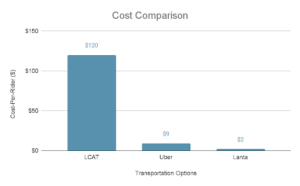
Figure 2. Cost-Per-Rider
The cost-per-rider for the LCAT shuttle is nearly 12 times more than Uber and 60 times more than LANTA public transportation. Assuming that there were only 297 times a student needed a ride to Metzgar this semester, it would be more cost efficient for Lafayette to have paid for their Ubers. If the school paid for 297 Uber rides to Metzgar it would cost them about $2,700 total, ultimately saving the school $32,000 this semester. Obviously, assuming that the school would pay for students’ Uber rides is unrealistic, this highlights how economically inefficient the shuttle really is. Why is it that Lafayette is comfortable paying so much for a shuttle that is severely under-utuilized? This leads us to the main obstacle, liability.
Challenges: Liability
Lafayette College is obligated to provide free-to-us public transportation for a number of reasons; these can be consolidated into one word “liability”. Lafayette has multiple locations that are outside of the school’s main campus, such as Metzgar, the arts campus and LaFarm. If a student were to travel to one of these places and get injured in a car accident, Lafayette cannot be blamed for the situation because of the shuttle services they provide. Without getting too in depth on the logistics of the liability concerns for the school, the point is clear, the college needs to offer public transportation to serve as a “liability-based cushion”. From an economic standpoint, the school does not mind paying $70,000 annually for a single shuttle because it saves them from any liability concerns in the case of an accident. That being said, even if the school could save $32,000 by simply paying for the 297 Ubers this semester, they wouldn’t because of the risks associated with not having liability-control over students’ travel.
Economic Outcomes
Due to the liability challenges we face, the best path forward to create an economically efficient LCAT is simple. The first thing to consider is that the LCAT is here to stay because the school is obligated to provide students with free-to-use transportation. That being said, if our proposed route changes and enhanced marketing of the shuttle can increase student-utilization, the cost-per-rider will decrease. Think about it like this, Monday through Friday the LCAT takes 12 trips to Metzgar each day, that’s 60 trips per week and 900 trips a semester. If there were only about 300 times a student used the LCAT this semester that means that for every 3 trips the LCAT takes to Metzgar, there is 1 rider. If we were able to get 1 rider on each trip, the cost-per-rider would decrease from $120 to $40. The point is that even the slightest increase in ridership would create a significantly more economically efficient shuttle. We believe that a reasonable cost-per-rider goal would be around $10 (roughly 4 riders per trip) and we similarly believe that our recommendations for the LCAT will land us in that range.
Click here to go to the next section: Technical Context and Proposals