Summary
The LCAT shuttle that takes students to and from Metzgar Fields Sports Complex is severely underutilized and the college is in search of an affordable, yet efficient solution. Through our social analysis of the shuttle, it has become apparent that the majority of students are simply unaware of the LCAT and how the system works. Furthermore, the small portion of students that are aware of the LCAT find it to be inconvenient and would prefer to drive themselves to Metzgar. Our political analysis of the system taught us that in order for change to occur, the best way to do so is through Sandra Rogers (assistant director of public safety). Sandra told us that with reasonable evidence and a strong proposal, she will be able to set up a public hearing surrounding the LCAT’s situation and a successful hearing will result in public safety making adjustments. The economic analysis of the shuttle highlights the complexity of the system’s financial structure between the college, the athletic department, public safety and Easton Coach. Additionally this section shows the importance of the current $120 cost-per-rider and how our recommendations can lower this number to a more economically reasonable and efficient range. The technical analysis explains our recommendations to the college: Adjusting the LCATs routes and pick-up spots aims to enhance student convenience and naturally boost shuttle ridership. Elevating the marketing and promotion of the LCAT alongside its free-to-use mobile app, ‘Ride Systems,’ will heighten awareness among students, leading to increased ridership.
Looking Forward: Suggestions for Future Students
Initially our group had planned on setting up a public hearing with Sandra Rogers, but due to time constraints we were unable to do so. In the political analysis of our study, we have outlined how that process works and recommend that future-students can finish what we started. Sandra Rogers contact information, as well as other resourceful individuals, will be provided at the end of this paper for future groups to pick up where we left off. Additionally, the biggest challenge that we faced in this study was a lack of economic understanding. An obstacle that we were unable to overcome was the schools reluctance to share specific economic information regarding the shuttle. Before a future group considers a public hearing, it would be crucial to have a better understanding of the economic aspects surrounding the LCAT shuttle.
Something to Consider: Adding a Stop at LaFarm
There are multiple classes offered at Lafayette that take place at LaFarm and the transportation the school offers does not include drop-offs there. That being said, we would have implemented this into our proposed route changes, but we became aware of this additional problem late in the semester. We first thought that because we are suggesting eliminating the shuttles stop at the intramural fields, we could simply replace that stop with LaFarm. Since we had already decided that shortening the length of the shuttles round-trip would make for more frequent trips, we ultimately decided that we valued frequency over adding a stop at LaFarm. One last thing to consider is that LaFarm is certainly within walking distance of Metzgar (see figure 8), we leave it to future groups to decide if having 2 stops this close to each other would be efficient and essential or if it is simply unnecessary.
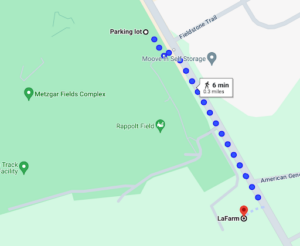
Figure 8. Walk from Metzgar to LaFarm
Click here to go to the next section: References