LaFarm Governance Structure
LaFarm’s governance structure consists of a board of faculty and student advisors as well as community representatives. The board of faculty advisors is made up of five faculty members from various disciplines. According to Dr. Nkansah-Dwamena, one of the five faculty members, the role of the LaFarm faculty advisor is to “facilitate connections between the practical experiences gained at LaFarm and the broader academic context.” The faculty advisors are important stakeholders for LaFarm and they play a crucial role in bridging the gap between student research and real-world applications. Their input on functionality at Lafarm is paramount to addressing the key challenges facing the greenhouse. In addition to faculty and administrative advisors, farm manager Josh Parr, student apprentice Olivia Simione, and student advisor Samantha Natividad are other important stakeholders involved in the everyday workings of the farm. They are equally important players and offer unique and divergent perspectives on the research questions posed in this project.
Lafayette College Governance Structure
Lafayette College is an independent corporation established by the comCommonwealth Pennsylvania in 1826. The governing board of the college consists of the Board of Trustees, Officers, Executive Committee, Standing Committees, and Student Associates. The Board of Trustees is made up of 35 board members and they have the power to “appoint [their] own officers, to make and enact ordinances for the government of the College, to elect Trustees, and elect or appoint the president, officers of instruction, administrative officers, and other employees of the College” (Lafayette College, n.d.). Within the board of trustees, there are various standing committees under which Lafayette students can be appointed by the student government to serve as associates for one academic year. Student government serves as a governing body on campus by creating liaisons between the student body and the college administration. While the college does not directly regulate daily operations at LaFarm, stakeholders such as the board of trustees have been previously involved in implementing large-scale projects such as the greenhouse. Thus, understanding the governance structure of the college is crucial to assessing the decision-making process behind implementing this project and potential ways the administration can be involved.
Aesthetic Politics & The Participatory Decision-Making Approach
Due to the inherently artistic nature of this project, it is necessary to assess the aesthetic politics at Lafayette College; or more simply put the dominant narrative of what is considered to look good for the college and who makes those decisions. While this project focuses on improving functionality at LaFarm, the art piece itself cannot be detached from functionality as they are both instrumental to the design of this project. Due to this symbiotic relationship between functionality and art, it is necessary for the adopted aesthetic of this art piece to be studied, particularly from a political standpoint. The politics of aesthetics are intended to identify how the artistic choices made throughout this project can either serve to advance a dominant narrative of what is considered beautiful or contribute to forging a stronger inclusionary connection under a common Lafayette identity. Scholars have theorized about the politics of aesthetics specifically in the context of community gardens suggesting that within these spaces often dominant views of what is considered aesthetically pleasing are prevalent (Montefrio, Marvin et al., 2021). The holders of these dominant views are often those with the most power under governance and political structures, and in the case of Lafayette, this would fall under the administration and the board of trustees. The LaFarm greenhouse as a community space necessitates a different approach to aesthetic politics and decision-making, an approach that would forge inclusion under participatory viewpoints as opposed to dominant ones.
Under current campus master planning, the Lafayette College governing body has employed a participatory approach to solicit input from various parts of campus on choosing furniture, amenities, etc. A version of this approach was employed in this project through a survey to solicit input on what solutions stakeholders think are the best fit. The participatory approach should be employed again in future implementation of this project to ensure that students and community members remain connected to the functional art piece and believe in its true representation of a shared collective identity.
Competing Visions
The current greenhouse reflects the competing visions between key stakeholders for the LaFarm space. After an initial discussion with Josh Parr, we learned of some key issues with the design of the greenhouse. A water system that is not weatherproof and a floor that is not pitched are examples of administrative failure to take into account the practical needs of the space and engage other stakeholders. Designers assumed the greenhouse would be operational year round, and therefore be temperature controlled. This is not the case. Designers also focused on the idea of the space as a classroom and did not have a full picture of the intended purposes of the space. While Josh Parr was consulted for the design of the greenhouse, some of his suggestions were not included in the final draft, and the resulting space has functional deficiencies as a result. The greenhouse has politics, its design and implementation were shaped by the goals and expertise of the stakeholders with the most power, with choices about different features having been chosen without the involvement of more knowledgeable stakeholders with less power. In this project, a different methodology was employed; one that involved conversations with various stakeholders whose perspectives have shaped the nature of this project.
Stakeholder Analysis
The LaFarm greenhouse has various stakeholders and as aforementioned their interest and active participation is vital to the implementation and sustainability of this project. The governing body’s stake in the success of this project rests on the intended mission of the greenhouse. The greenhouse was constructed with the mission of serving as an educational and community space where the community is in “alignment” (Nicole Hurd Lafayette News, 2022). Within LaFarm’s greenhouse identified stakeholders are the head farmer, faculty advisors, students, community gardeners, and various administrative offices, all of which fall into different stakeholder categories (see Figure 2).
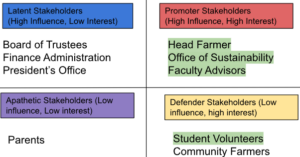
Figure 2: Stakeholder Mapping
Each stakeholder was placed into a category based on our conversations with them or their governing role. For example, all three administrative offices (board of trustees, president, and finance) were identified as latent stakeholders with high influence and low interest. This decision was made based on the limited direct interaction that these administrative offices have with the farm. However, considering their role in Lafayette’s governance structure, they have the social, financial, and political influence to implement the project. Stakeholders with higher interaction with LaFarm such as the head farmer, office of sustainability, and faculty advisors fall under the promoted stakeholders. Through interviews, these stakeholders were identified as having a high interest in this project. Faculty advisor Dr. Nkansah-Dwamena has voiced positive interest in the idea of a functional art piece in Lafarm’s greenhouse noting that “balancing functionality with aesthetic appeal could contribute positively to the holistic impact of LaFarm on its participants and the broader community.” These feelings were echoed by Samantha Smith from the Office of Sustainability. In an interview, she stated that the artistic nature of this project is a great way to “engage the community in new ways about sustainability, food access, and agriculture.” The defender stakeholders include student volunteers and community farmers because they also showcased high interest in this project. Despite having limited influence in the decision-making processes in LaFarm’s governing board, the voices of student volunteers were instrumental in this project. According to scholar Phil Rabinowitz, stakeholders’ interest should be identified when intending to employ a participatory process considering that “their knowledge of the community and understanding of its needs can prove invaluable in helping you to avoid mistakes in your approach” (2020, p.1). For example, student apprentice Olivia Simione works on the farm year-long and thus has firsthand experience on what aspects of the greenhouse are most and least functional. As president of LaFFco, the farm volunteering program, Samantha Natividad is involved in coordinating volunteering at the farm and thus has first-hand knowledge of directing student involvement. Both of these student volunteers, in addition to other students, were surveyed and their perspectives guided the decision-making process of this project.