All data and graphics in this report were created from LaFarm data and supplied to us by the Head Farmer, Josh Parr. Through the years, LaFarm has been an intersection of education, sustainability, and community. However, since 2013, it is apparent that the production aspect of LaFarm has taken over the limelight for the farming operation. Referencing Figure 1, it is clear that the yield of produce experienced tremendous growth over the years, even with production acreage barely increasing in the same timeframe. It should be noted that the increase in production from 2017-2020 can be attributed to the same person working as the head farmer. Each growing season provides experience with the land and niche knowledge for how to optimally grow produce. In 2021 there was a change in personnel with the head farmer position as well as a drought that occurred; this explains the sharp downtick in production yield for 2021.
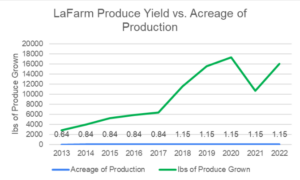
Figure 1
However, in considering alternative efficiencies, we must note the importance of LaFarm’s educational mission. Referencing Figure 2, when examining the classroom involvement at LaFarm, it shows educational outreach has not expanded on pace with the produce yield. However, the drop off in total classes at LaFarm from 2019 to 2020 can largely be attributed to the effects of the Covid-19 pandemic. Still, even when considering Covid-19 complications, the stagnation of classroom involvement at LaFarm remains apparent.
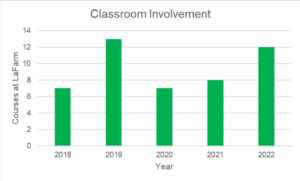
Figure 2
To address the challenges facing LaFarm we suggest reinstituting the former LaFarm website data as well as incorporating an integrated feedback system for the LaFarm website will create substantial improvement in the alternative efficiency scope considered in this project.
The historical online data of LaFarm fosters a sense of community by connecting past, present, and future stakeholders. It provides a shared history that unites visitors, workers, LaFarm Advisory Board members, and the broader Lafayette College community. This shared narrative not only strengthens the sense of belonging but also attracts individuals and organizations seeking to align with a community-oriented and historically grounded initiative. The documentation of past events hosted at LaFarm also becomes a promotional asset. Along with a dedicated staff, the farm can attract attention and interest from individuals who resonate with its mission by highlighting successful events, guest speakers, and community gatherings. Becoming a dynamic marketing tool, showcasing the farm’s capacity to host engaging and impactful events that extend beyond traditional farming practices. The wealth of information encapsulated in past records, including alternative farming practices, salon discussions, and events hosted at LaFarm, not only contributes to a rich tapestry of the farm’s journey but also serves as a compelling narrative for prospective stakeholders. Additionally, LaFarm can showcase its evolution and commitment to innovation in sustainable agriculture. The narrative of the farm’s journey, supplemented by documented successes, becomes a powerful testament to its adaptability and responsiveness to the dynamic changes of the community structure that surrounds LaFarm.
The integrated feedback system would serve as a bridge, facilitating communication, enhancing collaboration, and promoting a holistic understanding of LaFarm’s operations among its diverse stakeholders. Ultimately it would provide visitors, workers, and stakeholders a platform to share insights, observations, and suggestions to be compiled on a platform for other users to access the information captured. Currently, there is no proper outlet for most Lafayette students to offer feedback on extended experiences regarding LaFarm. There exists an end-of-semester survey for paid student workers sent out by Joshua Parr. However, the main drawback is that paid student workers represent a small fraction of the total participants at LaFarm. For student volunteers, there is a QR code in the greenhouse to allow check-in for all students. However, this metric effectively only tracks the number of attendees and does not gain sufficient feedback from a much larger percentage of the student body. An archive of LaFarm experiences would break down silos and enable a continuous exchange of information between the practical aspects managed by the Head Farmer as well as the academic perspectives brought forth by professors wanting to engage their classes with LaFarm. By fostering transparent communication, this system would bridge the gap that currently hinders the integration of practical experiences and academic insights. By capturing the perspectives of visitors, workers, and academic contributors, the system generates valuable insights into the strengths and weaknesses of current operations. When considered in conjunction with the goals set by the Office of Sustainability, this now accessible data can inform any LaFarm patron about events or opportunities, provide information on farming practices, and ultimately shape a visible path of historical growth. In this way, the system becomes essential to ensuring the farm’s overall health, aligning its educational outreach goals with production objectives while fostering innovation and adaptability.
The proposed enhancements to the LaFarm website would take the form of two additional links among the existing list of LaFarm sites. A simple graphic of what this enhancement would look like is shown in Figure 3.
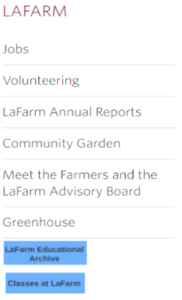
Figure 3
The “Classes at LaFarm” section, would land a web user on a page with a “Student Testimonials” and “Upcoming Classes” section as depicted in Figure 4. The Student Testimonials section would preview several student responses regarding their educational experience at LaFarm. The only prompted question for the response being, “How did LaFarm aid in your educational growth?”. This would provide students, professors, and LaFarm staff with at least some form of data collection regarding the educational outreach goal of LaFarm. Additionally, the Upcoming Classes section would list any classes that have a component that takes place at LaFarm, whether that is only once a semester or more consistent LaFarm visits. This would provide prospective and current students with access to course offerings and schedules.
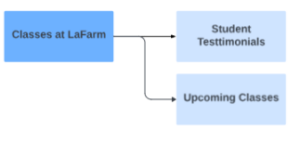
Figure 4
Further expanding the educational outreach of LaFarm, the “LaFarm Educational Archive” would land a web user on a page offering a comprehensive repository of learning materials shown in Figure 5. These materials would include online resources, books, and films all about farming, community gardens, or college farm practices. The majority of this information would be pulled from the old LaFarm website; a process that would surely involve sifting through the old website information to formulate the desired content for the newly integrated sections.
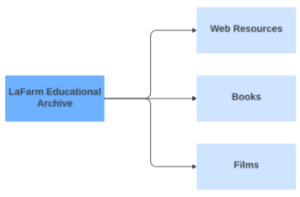
Figure 5
All the components of the proposal for enhancing the LaFarm website would surely involve a software infrastructure professional to be completed. Initially, during the extraction phase, any redundant, outdated, or irrelevant data that is not a book, film, or online resource would be purged and not added to the new LaFarm site pages. The LaFarm website runs on a content management system (CMS), called WordPress, with PHP as its programming language. This enables historical data incorporation through built-in functionalities or plugins and would be a relatively straightforward task since the script from the old LaFarm website can be used. However, the design of the new website must reflect the current website’s overall theme, ensuring a unified user experience while mirroring the main site’s navigation structures, typography, and color schemes in the new sections. Consistency is crucial, especially when presenting historical data and event information, as it aids in crafting a cohesive narrative about LaFarm’s legacy and operations.
A dedicated staff member’s role becomes paramount in the maintenance and content strategy of the Student Testimonials page. Moreover, the technical upkeep of the new website is an ongoing commitment. This involves routine CMS updates, security checks to safeguard against cyber threats, and regular data backups to prevent loss. The staff member must also engage in Search Engine Optimization (SEO) practices to enhance the website’s visibility and ensure that the content aligns with LaFarm’s broader marketing and outreach goals. It requires careful planning, consistent design integration, and a commitment to content creation and technical maintenance, all of which underscore the need for a dedicated staff member. This addition serves as a portal to LaFarm’s rich historical and operational narrative.