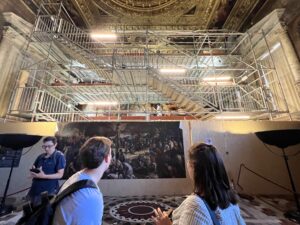
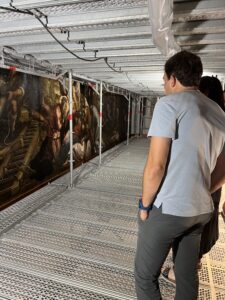
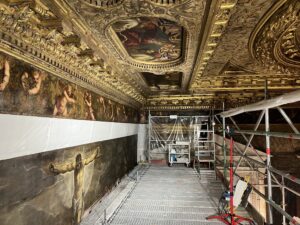
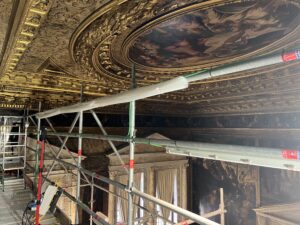
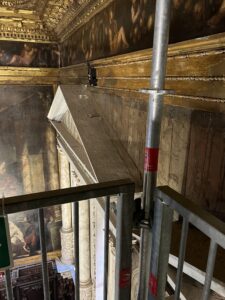
We visited the conservation of Tintoretto’s oil on canvas painting “Crucifixion” in the Grande Scuola di San Rocco, climbing up into the scaffolding and seeing the painting up close. The painting stretches from floor to ceiling, an enormous 17.5 feet wide and 40 feet tall. The entire painted surface had been cleaned when we arrived and there was but a small amount of retouching work before the scaffolding and covers could be removed.
We talked briefly with one of the conservators working there, learning about the different imaging methods and analysis the painting underwent before any varnish or paint was touched. Much of the canvas structure was damaged from old binding techniques, old conservation work, and general moisture and grime in the
building. The lead roof of the Scuola has also leaked over the years, introducing many issues to not just “Crucifixion,” but the other frescos and paintings in the room as well.
One interesting thing we learned was about how such large canvases are produced. In Tintoretto’s time, looms had a maximum canvas width and to achieve a monumental painting scale, multiple of these strips would be sewn together. This classic technique is relatively straightforward, although problems arise once the threads degrade over hundreds of years. This was one of the larger hurdles in conserving this painting.
After we visited the painting, we attended a patron’s talk and panel about Save Venice’s work on Tintoretto pieces over the foundation’s lifetime. The presentation was interesting but hard to understand as it was completely in Italian. It was good practice and immersion for us though!
Here is Save Venice’s informational page on this work: https://www.savevenice.org/project/jacopo-tintorettos-crucifixion-in-the-scuola-grande-di-san-rocco
Please see the pictures below from our visit!
0 Comments