
“Frames are a structure for perceiving and presenting things, highlighting specific connotations in selecting and processing things, and expressing ideas reflecting a specific cultural value” (Luo and Ling 2023).
The concept of framing first emerged from studies on communication and marketing. This term initially referred to marketing strategies designed to appeal to consumers. Message framing operates by either drawing attention to the negative traits of competitors or highlighting the positive characteristics of the product. Brands can opt for a more pull or push scenario by focusing on different aspects of an individual’s emotions (Masullo et al. 2024; Yu 2012). Framing, therefore, relates not only to how a message is conveyed but also what it is likely to cause a person to do.

Sociologist Irving Goffman revolutionized the study of framing by adding the dimension of dramaturgy and applying these principles to the study of media coverage and public opinion. Dramaturgy likens social interactions to theatrical performances with people engaging in impression management as they “act” different on “front” or “backstage.” In this case, students are the leading actors in on-campus protests. They may occupy the role of activists, reporters, or even impacted bystanders. Other actors might be the college administration, professors, police, or even politicians. Goffman’s work sought to describe how people translate “social reality into subjective thought” (Allern 2014; Luo and Ling 2023; O’Boyle and Li 2019; Van Gorp 2014). Framing is what makes it possible to conceptualize how social meaning is built, rebuilt, and maintained over time (Allern 2014; Van Gorp 2014).
Key Terms
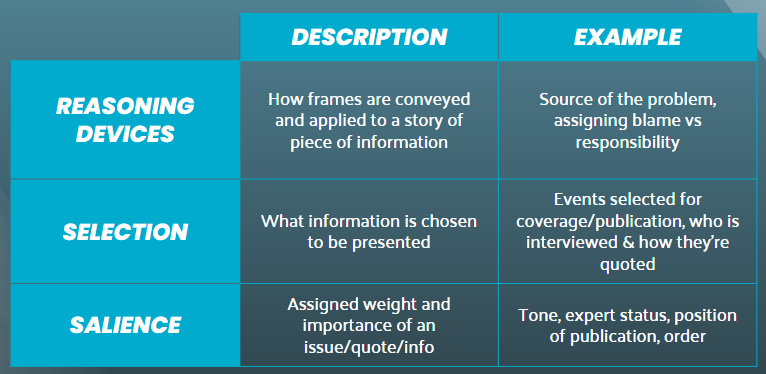
When understood as a whole, frames operate to structure how new information is interpreted. Journalists often rely on existing cultural schema when presenting news to build a central theme and facilitate reader comprehension. In turn, this perception guides future actions taken (Luo and Ling 2023). Luo and Ling compare frames to a funnel, while Van Gorp likens them to an accent mark that slants how information is taken in (Luo and Ling, 2023; Van Gorp, 2014). Allern describes how the news media coverage will attach greater importance to influential frames that confirm these existing ideas, similar to confirmation bias (Allern 2014). Information at this level becomes a subconscious filter through which later information is processed.