
Defining Protest
The general definition of a protest encompasses a degree of planning, focuses on a perceived injustice, and seeks reform. Many protests are also intentionally disruptive, designed to draw attention and garner support for their cause. The media and activists have a tenuously symbiotic relationship with each other (“Ask the Expert: Media Coverage of Protests Focuses on Spectacle, Not Substance,” n.d). Protestors rely on news coverage to disseminate their message. Visible demonstrations are oftentimes just one part of a social movement’s effort to achieve legitimacy and meet its goals (Culver and McLeod 2023; Masullo et al. 2024). Other examples include social media campaigns, hosting speakers, or promoting fundraising events. The scale and visibility of protests are more likely to draw media attention. Culver and McLeod describe the spectacle of protests as a “lightning rod” for journalists (Culver and McLeod 2023). The media needs to report on compelling stories, such as those offered by the activists (Culver and McLeod 2023; Van Gorp 2014). Today’s hybrid media enables consumers to access information from a variety of sources as media forms become integrated into the audience experience (Masullo et al., 2024).
Protest Paradigm
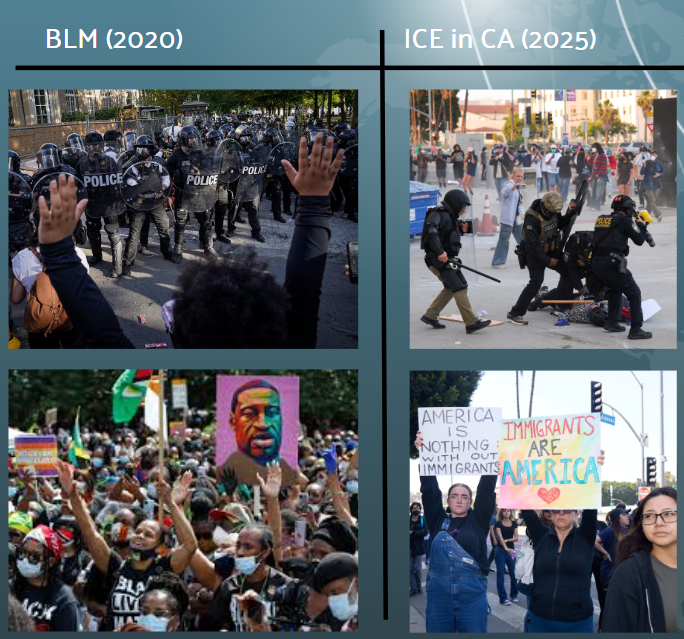
Protests can look very different depending on where you stand in a literal and figurative sense. The media has the power to bridge this gap or widen it into a chasm. The problematic aspect of this paradigm emerges from the overly hostile response of the public to protests, regardless of the actual substance of activist efforts (“Ask the Expert: Media Coverage of Protests Focuses on Spectacle, Not Substance,” n.d; Culver and McLeod 2023; “Students Push Back on Protest Coverage; Share Media Concerns” 2024). A more balanced approach to reporting, instead, prompts a sympathetic response to similar events. People may not always agree, but they are more likely to listen with an open mind as news coverage shifts away from the protest paradigm (McLeod, 2020). Activists are caught in a double bind, needing to remain calm to be taken seriously when articulating their demands, yet also needing to act out in some way to draw attention to their cause (Culver and McLeod, 2023; Masullo et al., 2024).
Masullo, Brown, and Harlow expand on this idea by researching the effects of framing on the perceived legitimacy of social movements. Humanizing protestors and centering activist voices was found to have a significant impact on how social movements are perceived. News coverage revealed a concerning pattern of not only criminalizing these activists but also delegitimizing their demands in comparison to other issue-driven protests (Culver and McLeod 2023). To combat this form of reporting bias, journalists are recommended to engage deeply and frequently with the communities they report on. When this is not possible, readers are encouraged to rely on news that does have these connections (“Ask the Expert: Media Coverage of Protests Focuses on Spectacle, Not Substance”). Context is crucial for accurately depicting protests and challenging the hegemonic roots of U.S. journalism (Masullo et al. 2024).
While these issues provide an essential foundation for teaching ethical journalism, further research is necessary to understand how they manifest in various news production contexts. The focus of this research addresses one such environment by honing in on the substance of student journalists covering protests on their college campuses.