
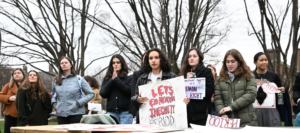
If you were to ask me what defines my Lafayette experience, I would say LRAJE. LRAJE (Lafayette for Reproductive Autonomy, Justice, and Empowerment) is a student-run organization that seeks to educate, advocate, and provide necessary reproductive services to the community. Leading this organization has helped me grow immensely, especially into the role of student activist. I spent the majority of 2024 campaigning for free menstrual products on campus as part of LRAJE’s Menstrual Equity Project. After countless hours of research, networking, and dozens of emails, LRAJE accomplished our goal. Throughout everything, the same question would not leave my mind: “Why does this feel so much harder than it needs to be?” There had to have been better ways to accomplish our end goal, especially at a strong institution like Lafayette. The tides only turned when LRAJE involved the media and organized a campus protest.
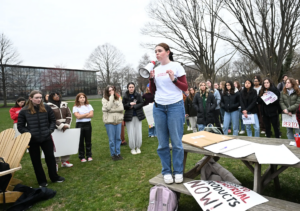
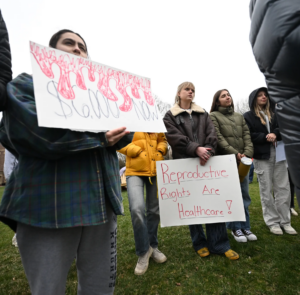
Media attention was centered around this visible display. As I found in later literature, the spectacle of protest is like a lightning rod for journalists (Culver and McLeod 2023). Activists are intentionally disruptive as they make their demands visible. The media is more than happy to pick up the story. LRAJE used this tactic in multiple ways. The president at the time, Sophie Himmell, posted a long video on her Instagram account to share LRAJE’s goals with a larger audience. When planning our demonstration on the quad, we made sure to inform The Lafayette (a student-run newspaper) and The Morning Call (a local news outlet) about the event. These strategies helped LRAJE gain control of our narrative. I do not think it was a coincidence that we were offered a meeting with campus administration just days later.
My experience with LRAJE and helping to organize a protest sparked my research interest. I first began to investigate the topic of student activism in my Research Methods and Design class within the A&S department. This interest proved to be much more complex than I had imagined. My paper, “Student Movements within Colleges and Universities: Reaching an Understanding between Students and Administrators, applied a sociological perspective on identity to better understand how student activists chose to act on their college campuses. I focused on intra-organizational movements, taking a micro-level approach to protests where students demanded campus-specific change and actions. The Menstrual Equity Project would be a perfect example. However, similar movements are difficult to find and may encompass a wide range of issues. This class assignment was more of a proposal than anything else. I knew that I needed to look deeper into the literature and find the bigger picture of student activism.
I delved deeper into the topic of student activism in Theories of Society. This paper looked closely at activist-centered research and the impact of participation on identity formation. I again relied on Goffman and sociological frameworks. My questions went deeper into the individual, but still, I knew that something was missing. Applying for DHSS presented me with the opportunity to take another crack at researching student activism.
With guidance from professors and librarians, I asked myself again, “What do I really care to learn?” My answer appeared both suddenly and obviously. I want to understand how social movements are perceived by their communities and how this perception might affect the strategies activists choose. As a student who lives and breathes my campus community, it made sense to ground this research in the college experience. My involvement with LRAJE moved me further into reproductive justice and the overturning of Roe v. Wade through Dobbs.