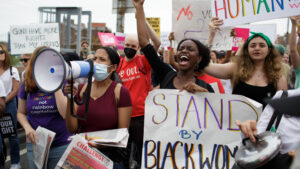
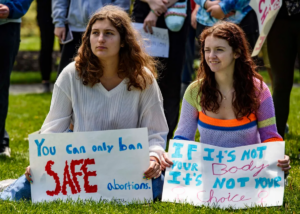
The Supreme Court’s majority in Dobbs vs Jackson Women’s Health Organization sent shockwaves across the country in June of 2022. The writing was already on the wall after this decision was leaked just weeks before. This case was significant because it shook the foundation upon which governmental protections for abortion stood. No longer were the Constitution and privacy rights able to protect this healthcare service. State and local politics were thrown into a frenzy across the country as dozens of trigger bans were locked into place. These laws were passed in anticipation of the Dobbs decision. Many states, such as Pennsylvania, were even more tense as the midterm elections loomed ahead in the fall. Journalists of all levels and beliefs grasped onto this tension as they attempted to cover this sensitive topic. Similarly, tens of thousands of activists made their voices heard through protests. College campuses emerged as one such site of activism (Kempton 2024).
March in NYC to protest the overturn of Roe v. Wade (NYT)
Youth activism is a well-documented phenomenon that has deep historical roots. US history is marked with spikes in protest activity as local, national, or even international politics unfold. Depending on the generation, mention of college protests might spark memories of the Kent State protest against the Vietnam War in 1970 or the more recent pro-Palestine encampments at Columbia University. It is no surprise that a monumental event like the overturning of Roe v. Wade sparked activist responses across the country.
Lafayette students attend a protest against the overturn of Roe v. Wade in Easton (The Morning Call)
This project looks to apply the sociological principles of framing and the protest paradigm to student coverage of on-campus protests related to the Dobbs decision. Framing defines how the presentation of information may influence how it is perceived, fit into existing frameworks of knowledge, and acted upon. This is done through what is chosen to be included (selection) and the prominence and relative importance assigned to information (salience). As discussed further in The Framing Effect (LINK PAGE) and Protest Paradigm (LINK PAGE), existing research has examined how social movements are presented by the media. Activists have expressed concerns that their goals are mispresented as news coverage creates a narrative of their own. However, alternative media, outside of primary news outlets, has been proposed as a way to combat bias in the coverage of protests. Student-run newspapers are one such example (LINK PAGE).
Building on previous work (LINK PAGE PD), my research questions are as follows:
How do college student newspapers frame coverage of Roe v. Wade protests? Does this coverage fit within the Protest Paradigm or does it work against it?
What does coverage look like at different types of colleges? Do student-run newspapers frame protests on Roe v. Wade differently?
These questions address the initial focus on how student-run papers frame protests, but also factor in the inherent differences in colleges. I am working under the idea that student coverage of a paper like The Lafayette may be different than the Daily Bruin at UCLA or even the Yale Daily News. Overall, the goal of this project is to investigate if alternative news sources like student-run papers operate outside of the more-documented biases in mainstream media.