Month: December 2018 (Page 2 of 2)

Vegetarian Blog Post #5

As my final week of my vegetarian journey comes to a close, I have ultimately realized that this lifestyle could be very practical for me long term. My body has completely adjusted to the dietary changes, and I feel better than I ever have before. I have a strong feeling I’ll continue sticking to this lifestyle from here on out.

On my previous post, I discussed the topic of iron related issues that can arise throughout one’s transition into vegetarianism. On that post, I received a comment from someone asking if I could further address the possible money related issues regarding vegetarianism.

When tackling the reasons for why the rates of vegetarianism is so low in the US, I immediately assumed one reason could be that it takes less meat to fill you up than vegetarian food, which made me believe that it would ultimately be cheaper to follow a diet containing meat vs not. I also came to this conclusion off of the fact that the menus at fast food chains (which more than 1 in 3 americans eats at on a given day) contain little to no fruits and vegetables. Since the food items at those chains are so low, I figured their ability to make their prices so low correlated with their lack of vegetarian items. It turns out my assumptions are actually completely false.

Vegetarianism can be a somewhat harder diet to follow for numerous reasons, like the effort it takes to prepare delicious & filling vegetarian dishes, but the idea that maintaining a vegetarian diet is proportionally more expensive than meat is simply false. In a study posted in the Journal of Hunger & Environmental Nutrition, it concluded that not only are vegetarian diets linked with better overall health, but that vegetarians (on average), save about $750 more per year than meat eaters. The vegetarian diets this study was based off of not only costed much less, but also contained much higher amounts of nutrition (via fruits, veggies, and whole grains) within its 2,000 calories when compared to the regular diet. A misconception about people following a vegetarian diet is that one must shop solely at Whole Foods and Trader Joe’s and buy all organic food in order to be a successful, satisfied vegetarian. But in reality, as long as your diet follows the no meat rule, you can utilize any and all things in the grocery store, organic or not.

Often times, food companies will stamp “organic” on their product, allowing themselves to increase the price. Though there are varying opinions regarding the actual value of organic vs. inorganic food, if you’re trying to save money, there’s truly no harm in buying non-organic stamped food. Pasta, dairy, pizza, eggs…etc. The vegetarian diet isn’t, and shouldn’t be considered restricting. The bottom line here is that prior to (my) prior belief, following a vegetarian diet does not mean spending higher amounts of money per year, and if you do it smartly, you could end up saving lots.
 

Amnesty Post #5

Gregory Bove

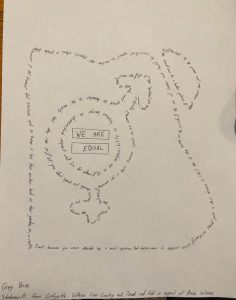
Through the course of the semester, I developed my idea from a simple fund supporting Azza Soliman’s cause for gender equality in Egypt into an idea which required ultimately no money, and was able to support her cause while also allowing me to become closer with the cross country and track team here at Lafayette. Through them, I created a piece of art which communicates the message of equality.

Attached is a photo, which is an outline of Egypt with a gender equality sign in the middle. All of the lines are constructed from sentences that my teammates wrote regarding the importance of fights against inequality and injustice in our world.

I thought that the personal project would be more of an academic ‘to-do’, but in reality it was a confidence builder for me, as I had to talk with others who I normally do not talk to, and it was a team building exercise, as I became more acquainted with my team members, and them with each other.

So, after looking to Amnesty.com to find out about Azza Soliman, I was ultimately able to help her cause while helping a cause of my own, which I thought was special. 

Vegetarianism Entry 5

As I have mentioned in the previous entries, the meat industry is full of unethical practices. For years the industry was able to keep these unethical practices hidden, however, articles, books, and documentaries have brought them to light.
The factory farming industry is focused on maximizing its output and minimizing its cost of production, to gain the most profit. This especially applies to the U.S. meat and poultry industry, which aims to make its products faster and bigger. One of the ways the industry tries to minimize its costs is by feeding animals, such as cows, corn. The U.S. government subsidies corn, as a result, farmers produce and sell corn at really cheap prices. These meat companies then feed it to cows, that are designed to eat grass. When cows are fed corn, dangerous mutations can occur and in some cases, the bacteria E. Coli evolves. This deadly bacteria can easily spread from one cow to another since these animals are kept in crowded and filthy feedlots. E. Coli can also contaminate vegetables such as lettuce and spinach because of runoff from factory farms. In addition, ground beef at the grocery store has thousands of cows mixed up in it, which increases the likelihood of the meat being contaminated with a disease.
To meet with the demand for Chicken, companies are raising them in half the time, but making them double the size they were in the 1950s. Scientists have also designed chickens to have larger breast because white meat is popular. Chickens are fed a diet of genetically modified feed, they are given antibiotics and other growth enhancers. This leads them to grow so big that their bones can’t keep up with their weight and they are unable to move. The chickens live in horrible conditions, they are kept in crowded cages and they often have no access to sunlight. Their condition provides breeding grounds for bacteria and mutations.
Furthermore, meatpacking is one of the most dangerous jobs in America and it is done by a lot of undocumented immigrants and poor people of color. They are often exposed to infections and diseases. Workers also suffer from a high number of injuries.
One should consider these factors when they go to the grocery store to purchase meat. They should consider their health, their family’s health, the mistreatment of meat industry workers, the environmental pollution and the suffering of animals. Throughout my personal project, I have learned that the process of changing to a vegetarian or vegan diet is challenging, but it is worth a try.

Citations

Food, Inc. By Robert Kenner, Robert Kenner, Robert Kenner, Richard Pearce, Eric Schlosser, Eric Schlosser, Melissa Robledo, William Pohlad, Jeff Skoll, Robin Schorr, Diane Weyermann, Elise Pearlstein, Elise Pearlstein, Kim Roberts, Kim Roberts, Michael Pollan, Michael Pollan, Gary Hirshberg, Joel Salatin, and Mark Adler. Directed by Richard Pearce.


Vegetarian Personal Project #5

I have really enjoyed reflecting on my commitment to vegetarianism during the course this semester. It has been interesting to look at the various perspectives surrounding meat consumption and vegetarianism through talking to other people and learning about some of the main factors and influencers to one’s choice to become a vegetarian. For me, my reason is that I do not feel that I have any right to eat another animal just because I want to or that it tastes good. This I feel is very pertinent to Nonviolence. In our modern world with the many options and choices that we have each day, we can imbue meaning and purpose in even the most mundane aspects of daily life such as pursuing a vegetarian diet. I feel that this experience has brought me closer to the food that I eat as I am more careful and aware of the types of food I am eating and where it has come from.

One major reason why I think vegetarianism has yet to really go mainstream in the United States is because of how disproportionally expensive fresh fruits and vegetables are in many areas. Furthermore, certain neighborhoods and towns have no access to produce without traveling far away by car to a neighboring town. This lack of access to inexpensive fruits and vegetables, I believe, is the major reason for unhealthy eating in America. As a direct result of immense government subsidies to Corn/ Grain and Dairy farmers, the price of less wholesome foods excluding fruits and vegetables is able to be marked down, making the price of produce artificially inflated in comparison.

In the end, I think that improving access to affordable fruits and vegetables to different communities is of most importance. It is a truly privileged ability of mine to pursue a vegetarian diet as I am not reliant on a limited quantity of food that I must survive on. Nevertheless, I have really come to appreciate the practice more than I did before.

Screenplay Personal Project Entry #5

  As this is my last post, I want to touch upon the various lessons I have learned throughout my personal project.  


  1. Art and nonviolence thrive in a symbiotic relationship. Throughout this semester, I learned about nonviolent action not only through my own project but also through others. I believe in order for there to be wider support for nonviolence, we have to view creative writing and other artistic pursuits as effective mechanisms for nonviolence. Many of the nonviolent cases that we have learned about would not have been a success without artistic pursuits, which bolster my project.  
  2. Writing a screenplay is difficult. I have been exposed to journalistic and other forms of creative writing in the past, but I have never endeavored to write a screenplay. It can be challenging, because not only are you writing a narrative, you are writing the production and reception of your narrative. At times, it was difficult to continue revising my vision and message to fit the confines of an acceptable screenplay, but it was worth it. Soulforce is still a work in progress, but I am proud of the work I have done thus far.
  3. There is still a lot of work yet to be done. By diving into my project and constructing and intimately knowing my characters, I acknowledge that there are people in the world who face challenges similar to those faced by my characters. Our world has a long way to go, but I believe peaceful noncooperation can change the world.  


   Moving forward, I will attempt to turn my screenplay into a film. I will edit the script during the break to reflect my continued dedication to this project and the lessons of this class. I am grateful that I chose this project, it certainly has been worthwhile. 

Newer posts »