The animal produc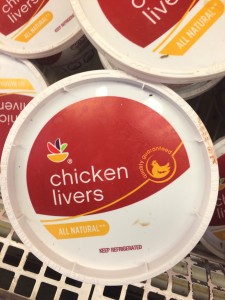 t I have chosen is a container of chicken liver. On the lid and side of the container, there is a picture of a hen sitting there. Above the chicken there is text that reads: “ Quality guaranteed”. The text forms a circle around the hen. I cannot tell if the hen is laying eggs or just sitting there. It is not a photograph. It is a realistic drawing. Right next to the hen, it has the name of the product, “chicken livers”.
From customer’s perspective, the hen depicted on the container is very peaceful. It can give customer a sense of safety that the livers they eat all comes from hens like this. Jonathan Foer would definitely say that the hen depicted here is very misleading. In Foer’s book Eating Animal, he goes into great depth to talk about the living condition of chickens. Firstly, these chickens are living in the so called battery cages. Each of the chicken just has sixty-seven square inches of floor space (Foer 47). This space is so small so that the chicken could not even sit there peacefully. The chicken we eat can never live a life as peacefully as the chicken in the picture. Also Foer points out that there are two kinds of chicken for farmers, broilers (chickens that become meat) and layers (chickens that lay eggs). And they are designed to be completely different: they have different genes, different bodies and even different metabolism (Foer 48), the image on this container is a layers, not a broilers. Further, on the lid of the can, bolded words say “ all natural”. There is no certain criterion that we could use to determine whether the food is natural or not. And under the circumstance that ninety-nine percent of the meat we eat today comes from factory farm, we are more than certain that the “All natural” here is just a gimmick. Even though one could claim that the hens we eat would never be like the one we see in the picture, we could never ban the company from putting the image on their product. It is just a drawing.
This can of chicken liver reflects the reality of the meat market now. Retailers tried their best make the general public believe the meat they eat comes from animals that are living in a way much better condition than they really are.
Works cited:
Foer, Jonathan S. Eating Animals. New York: Little, Brown and Company, 2009. Print.
Leave a Reply