Based on the results of our interviews, survey, and thorough research, our team devised two solution options, shown in Figure 10.
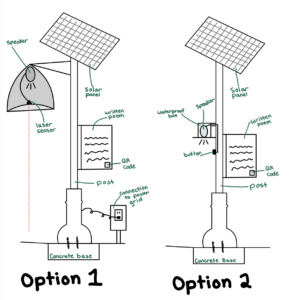
Figure 10: Solution 1 & Solution 2
These solutions are modeled on the specific type of lamp post featured across Lafayette College’s campus. Modifying these available lamp posts is an ideal option for the final design, as they capitalize on an existing structure. Since the lamp posts have functioned reliably on campus, a location less than one mile from the KSAT, they would prove a reasonable and sturdy installation in a similar environment like the trail. The lamp posts will be free for the project’s use, a benefit further highlighted within the Economic Context section (Wilford-Hunt 2024). Thus, using these already-available base structures will allow our project to prioritize sustainability in design and implementation. Specifications for the lamp posts are shown in Figure 11 (Roll Barresi & Associates 2016).
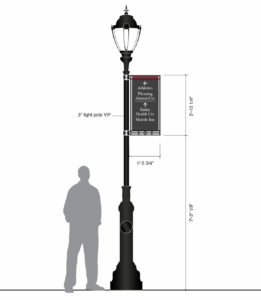
Figure 11: Lamp Post Specifications
Following a discussion with Professor Toia, we decided that the ideal height for the Spoken Word structures is roughly seven feet. The installations must be tall enough so users cannot reach the solar panel on top, and short enough to keep from distracting from the natural scenery. Thus, the lamp posts should be cut right underneath the base of the signage on the specifications, leaving 7’3” of height to work with for the art installation. Between the 3-foot and 5-foot marks, the front of the post will include written versions of the featured poem in English, Spanish, and Braille, as well as a QR code for users to scan and access the poem on a personal device.
In addition to sharing the lamp post base structure, both proposed solutions utilize a solar panel to generate energy for the speaker. However, the overall energy need differs between the two solutions based on their working components. The laser sensor in Option 1 increases the design’s energy demand, necessitating a connection to a power grid. However, in a discussion with Professor Toia, we learned that a power grid is not easily accessed from the KSAT (Toia 2024). Since Option 2, with its simpler components and accompanying lower energy demand, is expected to be completely operable under the provided solar energy, the second solution would be a less energy-intensive and more sustainable choice.
Another feature of both options is that the solar panel is connected to the speaker through wiring. All electrical components must be shielded from the outdoors to best ensure the functionality and longevity of the installation. In Option 1, this is accomplished by positioning the speaker at the apex of a cone, with connective wiring running through the center of the lamp post and into the cone. The cone serves the dual function of providing protection from the elements and funneling sound down toward the user once they step underneath and trigger the motion sensor. Since a large portion of the KSAT is adjacent to U.S. Route 22, a major highway through the Lehigh Valley, there is significant traffic noise that may distract from the poetry experience. The conical shape would help block outside noise, as they are often utilized in interactive museum exhibits for this purpose (Lopez 2024).
During our interview with computer science professor Christian Lopez, however, we learned that a laser sensor may not be the most reliable technology for our project. Lighting conditions, influenced by sunlight and the color of clothing that users are wearing, can interfere with motion sensors (Lopez 2024). We anticipate that most participants will use the installations during the day, so sunlight interference would be a challenge when using a motion sensor. Depending on the dimensions of the cone, only one or two people would be able to fit underneath it at a time. If users are on the KSAT with others, they may not be able to listen to the poem together. The physical limitations and lack of interpersonal connection posed by the motion sensor and cone combination steered our team away from ultimately choosing this technology.
Professor Lopez confirmed that using a push-button, as sketched out in Option 2, is a simpler and more reliable avenue for our project. Since Option 2 does not employ a cone to house the speaker, some other waterproof structure must be included to shelter the speaker from the outdoors. Finding one proved to be more difficult than expected, as a speaker-enclosing box must be unopenable by users and impenetrable by the elements, while not blocking soundwaves and remaining accessible for maintenance.
After presenting these first two options to Professor Toia, we concluded that Option 2 is more applicable to the project context. He provided ideas on how to improve Option 2 in order to address our concerns about the protective box, as well as his own concerns regarding the security of the electric components and accessibility to the poem itself. This discussion resulted in the creation of Option 2B, detailed in Figure 12.
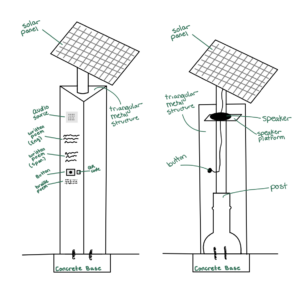
Figure 12: Solution 2B
Option 2B has a similar internal structure to Option 2, with some minor changes. In Figure 12, the diagram on the left shows how the installation looks from the outside, and the diagram on the right reveals its inner workings. Feedback from Professor Toia led us to pursue this final proposed design. For example, there have been past instances of vandalism on signage and art pieces along the KSAT (Toia 2024). Enclosing the entire mechanical structure ensures that users are unable to access expensive equipment. Additionally, having the poems written directly on the main vertical structure rather than on an appendage should help deter undesired behaviors (Toia 2024). For these surrounding panels, Professor Toia suggested using brushed or glossy aluminum due to its ability to be painted and withstand outdoor conditions. The lamp post itself is already constructed from aluminum, so we know the material is weatherproof and sustainable over long periods of time. Finally, from his artistic viewpoint, Professor Toia believes that Option 2B will better assimilate with the rest of the artwork than Option 2 would, as it will portray its clear message without incorporating many unnecessary parts.
Option 2B also solves the problem of finding a waterproof box for the speaker. Since the speaker will be fully enclosed within the structure, including at the top and bottom, there is no need to find an additional, smaller way of protecting the speaker. Another interesting feature of using panels in Option 2B is the streamlined ability to change the poem. The front panel, which will feature the poem in English, Spanish, and Braille, will be screwed on. Therefore, it can easily be replaced by a new panel with a different poem. The ability to remove the front panel will also come into play when maintenance is required. The other two panels will have room to incorporate visual art related to the poem’s content and themes, with the ability to be swapped or painted over when a new poem is introduced.
For the final proposal, our team sought to present a suitable speaker and solar panel combination. Following recommendations from Professor Lopez, we researched several speakers that can store and play a short poem. A comparison of the two final options is detailed in Figure 13.
| Speaker
Type |
Power Output (Watts) | Play Time (Hours) | Battery Capacity
(mAh) |
Charging Time (Hours) | Unit Cost
($) |
Dimensions | Features |
| BOGASING S8 Pro | 100 | 15 | 1500 | 2 | 170 | Depth: 2.56″ Width: 11.06″
Height: 4.33″ |
Type-C, USB, AUX, TF |
| DOSS | 12 | 20 | 2200 | 4 | 35 | Depth: 2.9″
Width: 6.6″ Height: 2.7″ |
Type-C, AUX, TF, LAD light |
Figure 13: Speaker Comparison
Due to its shorter charging time, higher power output, and USB capabilities, our team decided to use the BOGASING S8 Pro speaker. We believe these benefits are worth the higher unit price. The speaker’s USB feature is especially important for inputting and changing the recorded poem audio.
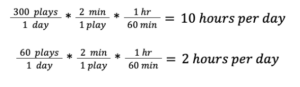
Then, to select an appropriate solar panel, our team determined the amount of energy the BOGASING S8 Pro speaker needs. These calculations were based on predictions of average poem lengths and the daily number of users. In the most ideal conditions, when the exhibit is newest and weather conditions are pleasant, we estimate that the speaker will play a maximum of 300 times per day. In the winter months, we estimate that the speaker will play a maximum of 60 times per day. Since each poem will likely be between 30 seconds to 2 minutes long, the maximum time the speaker might play per day is about 10 hours in the summer and 2 hours in the winter. Our calculations are shown below.
Our next set of calculations involved estimating daylight hours to determine where the structure must be situated to direct adequate sunlight to the solar panel. We considered two locations on the KSAT, near the 13th Street entrance and next to the dog park, as influenced by our research into the project’s social and political context. Utilizing the U.S. Naval Observatory’s data services, we inputted each location’s latitude and longitude coordinates to find the projected daylight hours based on records from 2023 (Astronomical Applications Department 2024). The results are copied in Figure 14.
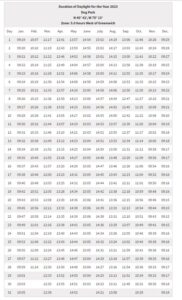
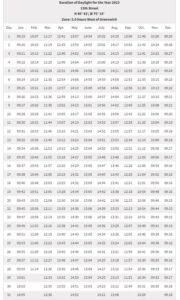
Figure 14: Daylight Hours at 13th Street (Left) and Dog Park (right) Sites
The charts yielded almost the exact same data since their latitude and longitude inputs are very close together. Another limitation of these results is that they do not incorporate shade from trees or other structures, accounting only for patterns of the sun. Despite these setbacks, we are able to use the charts to gain a rough estimate of the average daily sunlight on the KSAT each month. We also calculated this average for the winter (October – March) versus the summer (April – September), as shown in Figure 15 and Figure 16.
| Jan | Feb | Mar | Apr | May | Jun | Jul | Aug | Sep | Oct | Nov | Dec | |
| Average Sunlight per Day (Hrs:Min) | 9:38 | 10:39 | 11:57 | 13:18 | 14:27 | 15:02 | 14:45 | 13:44 | 12:27 | 11:06 | 9:56 | 9:18 |
Figure 15: Average Daily Sunlight, By Month
| Winter (Oct.-Mar.)
Average Daylight Time (Hrs:Min) |
10:26 |
| Summer (Apr.-Sept.)
Average Daylight Time (Hrs:Min) |
13:57 |
Figure 16: Average Daily Sunlight, By Season
Since the daylight tables do not account for shade, we needed to estimate the average amount of sunlight lost due to shadows and cloud coverage. Thorough completion of this process would be complex and require in-person observations over an extended period of time. To simplify the procedure to fit within the scope of our project, we utilized Google Earth images and personal experiences with the KSAT to reasonably determine shade coverage. Since the 13th Street location is surrounded by more trees and buildings than the dog park location, we are estimating that the 13th Street site loses about 4 hours of potential sunlight, and the dog park site loses about 2 hours, daily We compiled the table shown in Figure 17 based on these estimates.
| Location | Winter Average (Oct.-Mar.)
(Hrs:Min) |
Summer Average (Apr.-Sept.)
(Hrs:Min) |
| Dog Park | 8:26 8.5 | 11:5712 |
| 13th Street | 6:266.5 | 9:5710 |
Figure 17: Average Daily Sunlight, By Season, With Shade Factored In
During the winter, we expect required speaker play time to reach a maximum of 2 hours per day. During the summer, this estimate extends as high as 10 hours per day. Thus, demands on the speaker will differ between seasons. We selected the BOGASING S8 Pro speaker, which has a total capacity of 15 hours of play time between charges.
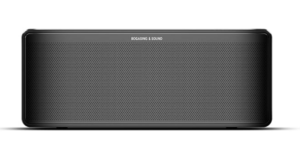
BOGASING S8 Pro Speaker
This speaker must be charged to at least 67% of its battery capacity during the summer, and at least 14% of that capacity during the winter. Calculations of the respective energy requirements are detailed below.

To calculate the required size of the accompanying solar panel, we utilized a formula based on daily energy consumption, daily average amount of sunlight, and a safety factor. The safety factor can fall between 1.25 and 1.5, and it accounts for variations in sunlight (VTOMAN 2024). Since our value for energy to the speaker is a rough estimate, we are using a safety factor of 1.5. The formula is:
Watts (solar panel) = [Daily Energy Consumption/Avg. Sunlight Hours]*Safety Factor
Since the 13th Street site receives the least amount of sunlight, we used that location to find how much solar energy must be generated to power the speaker at the capacities determined above. As long as the 13th Street site receives this adequate amount of sunlight, the dog park site should as well, as it features significantly less tree coverage. Our calculations with the formula are included below.
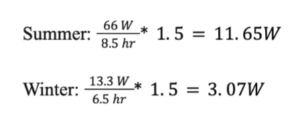
Our motivation for performing these calculations was influenced by our conversation with Professor Nicodemus, an Engineering Studies professor and expert in solar energy. Professor Nicodemus pointed us to the relations between energy received and energy required, in both ideal and actual scenarios (Nicodemus 2024). Rounding up from our summer calculation, our team concluded that the solar panel must produce at least 12 Watts of energy.
To account for the margin of error, we looked into 15-W solar panels and ultimately selected the ACOPOWER 15-W panel. We believe this option fits our project goals, as the panels are waterproof and have the ability to withstand high winds and heavy snow loads. These panels have the basic components for an off-grid system, making them a suitable option for the KSAT. The panels are made out of aluminum, matching the rest of our structure. The ACOPOWER device also contains a 12-V backup battery to store excess energy, which we believe will be essential for the final installations. On particularly sunny days, the solar panel will produce excess energy that can be kept in the battery and accessed during cloudy periods or at night, helping to minimize the effects of unreliable weather patterns.
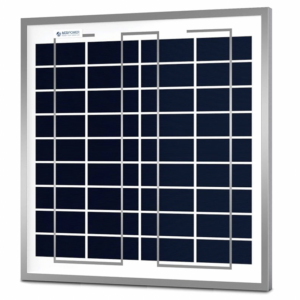
ACOPOWER 15-W Panel
Thus, our final recommendation incorporates a speaker and solar panel combination that takes environmental, geographic, and energy-related factors into account. Prior to developing prototypes of Option 2B, our calculations must be validated to ensure energy efficiency.
A digital Prototype of the final design is shown below:
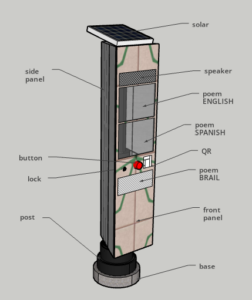
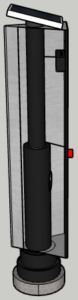
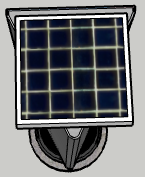
Prototype made using SketchUp