To entertain and educate trail users, the KSAT Spoken Word Project will feature sound art, a form of art that employs an audio component as its primary medium. Sound is not only a physical experience, but a mental one as well, so sound art has the capability to stimulate users in unexpected ways (Cobussen 2016). Historically, sound art has transformed public spaces by adding interactivity to visual art and engaging the auditory sense. Through interacting with sound art, users can further understand, relate to, and reflect on the meaning of a displayed piece (Cobussen 2016).
An example of successfully-employed sound art includes Philadelphia’s 2010 “Museum Without Walls” audio project. Launched by the Fairmont Park Art Association, Museum Without Walls is an artistic exhibit that publicly showcases sound art, allowing users to engage with sculptures through “narrative-driven soundscapes” (Norristown Times Herald 2016). The audio recordings were selected to offer insight into the intentions of the artists who designed the exhibit’s sculptures. Through the sound feature, artists such as Mark di Suvero were also able to explain their personal connection to the pieces. This perspective is accessible to viewers via cell phones, downloads, and streaming services. For mobile phone use, the project employs an app called BloombergConnects (Norristown Times Herald 2016). Locals and tourists alike are able to interact with the exhibit via its innovative use of sound art.
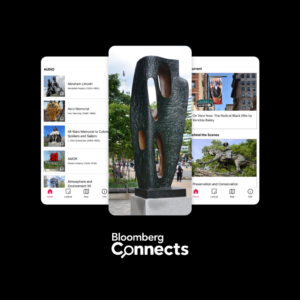
Interface of BloombergConnects app
Our team was inspired by the Museum Without Walls project, and we hope to employ audio in a similar manner in the KSAT Spoken Word Project to connect trail users to the area’s poets. The KSAT currently features many visual art exhibits, so the audio component of the Spoken Word will add variety to the viewer experience. For those less familiar with art interpretation, the audio removes some of that subjectivity, while still allowing users to have an individual reflection on a piece.
Our team understands the importance of thoughtfully designing for a specific group of users, and we intended for our project’s output to reflect that. In order to design a sound art technology that will positively impact the KSAT and the Easton area in which it resides, we first researched the city’s demographics to learn more about the community and its makeup. In Easton, 20.3% of residents speak a language other than English at home (U.S. Census Bureau 2020, 2022). This statistic led us to prioritize the incorporation of a second language into our design. Thus, we plan to offer two audio options, one in English and one in Spanish, the second-most-common language spoken in Easton. The user will be able to activate the English audio or the Spanish audio when engaging with the poetry installation.
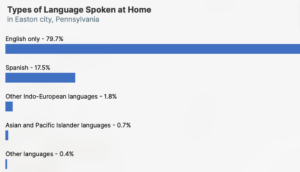
Chart from U.S. Census Bureau
Another important demographic consideration is that 14.1% of the Easton population is aged 65 years or older (U.S. Census Bureau 2020, 2022). Oftentimes, older individuals struggle with operating more modern technologies. At the same time, older adults tend to enjoy low-impact outdoor activities like trail walking, so we expect this population to fall into our intended users. To address this need, we intend for our design to be user-friendly and to offer instructions when applicable. We plan for the audio component to be activated by a simple button, an interface that is ideally accessible to all ages.

Chart from U.S. Census Bureau
Additionally, 2.9% of Easton residents have a hearing disability (U.S. Census Bureau 2020, 2022). With any auditory project, it is important to account for people who may struggle with hearing recordings coming from speakers, especially in an outdoor environment with many competing sounds. To address this concern, there will be a written version of the featured poem in both English and Spanish incorporated into each installation. The written poems will also be useful during any extended periods of maintenance on the audio system. And to accommodate users with visual impairments, we plan to include a Braille version of the poem alongside the written transcriptions.
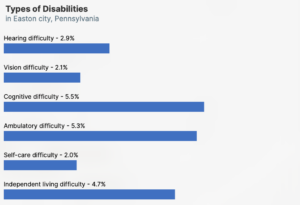
Chart from U.S. Census Bureau
These design choices align with the KSAT’s prioritization of functioning as an inclusive and educational space for all members of the community, regardless of background or physical ability. When considering accessibility, our team strove to address questions regarding how design choices can maximize inclusivity for different groups, such as speakers of languages other than English and individuals with disabilities. We wanted to learn which additional features could enhance the KSAT’s role as a welcoming community space through its newest artistic innovation. Following principles of universal design helped us better ensure that our project would reflect Easton’s diversity and invite equitable engagement.
Along with the makeup of the broader Easton area, we got a sense of the demographics of KSAT users via an online survey. While this survey was anonymous, we did ask participants to indicate their age range, how they typically access the trail, and their connection to the Easton community, among other questions regarding engagement with the KSAT. The survey was made on Google Forms and accessible via a QR code on fliers created by our team. We posted fliers in the announcement boxes at both ends of the trail, in the Simon Silk Mill complex, and around Lafayette’s main campus and Arts Campus. A copy of the flier put up near the Don Juan’s entrance to the KSAT is shown in Figure 4. The fliers were dispersed in early October and remained up through November. Within a month, our survey had garnered 19 responses, which we assessed collectively by utilizing the Google Forms analytics features. Some respondents indicated willingness to provide additional feedback and included their phone number. However, our team did not have any success with contacting these respondents for further participation.
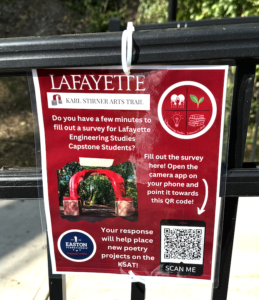
Figure 4: KSAT Use Survey Flier
From our survey results, we concluded that most trail users would be willing to listen to a poem during their time on the KSAT. One of our questions read, “How likely are you to interact with an art exhibit on the trail? (1 = least likely, 10 = most likely).” Over 75% of respondents provided a score greater than 5, indicating an inclination towards engaging with public art. Additionally, 78.9% percent of participants indicated that they enjoy listening to nature on the trail, so they may not be using headphones on the KSAT. Headphone users are less likely to stop and listen to a poem, as it interrupts their music, podcast, or phone call. If the majority of trail visitors are not wearing headphones, this supports our conclusion that they would be partial to listening to a new poem. And for the question, “What do you do on the trail?,” we found out that 100% of respondents use the trail for walking. People who are walking are more likely to stop and interact with an exhibit than people who are running, biking, or fishing, again showing support for and interest in a new art installation. The data is visualized below, in Figures 5 and 6.
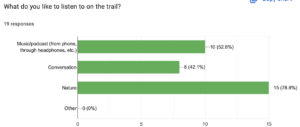
Figure 5: Listening on the Trail – Response
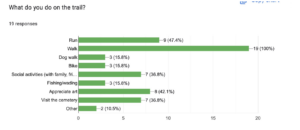
Figure 6: Trail Use – Response
The survey also helped us gather information influencing placement of the installations. We learned that 36.8% of users begin walking on the trail at the Silk Mill entrance, and that 60% of people walk the entire trail whenever they use it. The full data is shown in Figures 7 and 8.
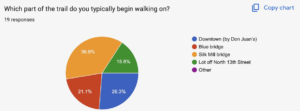
Figure 7: Trail Start Locations – Response
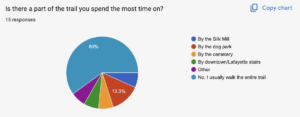
Figure 8: Trail Segments – Response
Along with additional factors discussed in the Political Context section, the survey results guided our team in selecting optimal locations for our poetry installations.