The Karl Stirner Arts Trail is an important component of the City of Easton’s ongoing efforts to revitalize public spaces and engage the local community. Stakeholders from the city as well as Lafayette College have played key roles in advocating for the KSAT, with each group prioritizing a slightly different vision. In 1999, the City of Easton and Lafayette College were jointly given a $9 million grant for the general improvement of the North 3rd Street and Bushkill Creek corridor (Finlay 2022). Both parties agreed on the construction of a trail, though their motivations varied. The city sought to create accessible green space for residents and upgrade a former silk mill into a residential and commercial entity, while the College intended to develop the area around its newly-purchased visual arts building. Ultimately, Easton Mayor Sal Panto enlisted stakeholder Richard McAteer to help steer the revitalization project. With the intention of turning the budding trail into a public art exhibit, McAteer involved Lafayette art professors Jim Toia and Ed Kerns, bridging the city-college divide and setting up the KSAT to become the interactive space it is today (Finlay 2022). This history highlights local politics and presents the KSAT as both a collaborative and somewhat contested effort.
Our team’s work on the KSAT Spoken Word Project is inherently shaped by this partnership. Professor Jim Toia, our main community contact and source of information regarding the public-private relations surrounding the KSAT, also serves as the trail’s Executive Director and Curator. Upon connecting with Professor Toia, he shared that a new grant of $10,000, from the Northampton Tourist Fund, has been allotted to the City of Easton for an innovative art installation on the KSAT (Toia 2024). He intends for the new exhibit to combine audio and visual media through poetry. Professor Toia envisions a series of simple structures, with room for artistic design and a user-activated sound component, as something that would be most successful on the trail (Toia 2024). He provided constraints pertaining to cost, size, and materials that ultimately influenced our design process. For example, the installation must be energy-efficient and solar-powered.
Professor Toia is part of the KSAT Advisory Board, which is subdivided to best guide decision-making and use of resources for the trail. These groups are the KSAT Inc. Board of Directors, the KSAT Arts Advisory Council, and the KSAT Lafayette College Advisory Council (Karl Stirner Arts Trail 2024). As a whole, the Board is composed of city officials, local artists, and representatives from the College. The Board will ultimately steer the direction of the Spoken Word Project, providing final approval of poem selections, installation locations, and strategies for engaging the public. Guidance from such a variety of stakeholders will ensure that our team’s work is beginning a project that reflects the values of the Easton community and upholds the KSAT as a valuable local asset.
With the values of Easton’s diverse community in mind, our team found it important to research and differentiate between “the aesthetics of politics” and “the politics of aesthetics,” concepts that often influence public displays. The aesthetics of politics explains how politics, on any level, can shape personal opinions and experiences (Park 2019). For example, art that serves to comment on society can help viewers make sense of current events. On the other hand, the politics of aesthetics describes how art can have its own influence on opinions and experiences (Park 2019). For example, modern art that challenges traditional art can show that there is no “right” or “wrong” in art, but instead there is room for subjectivity, something that can be transferred to other facets of life. With these two concepts in mind, our team sought to keep from creating or enforcing biases and instead offer room for creative thinking via our final proposal.
Since the KSAT is directed at all ages, our team sought to make the Spoken Word installations interactive and entertaining for everyone, including children and their caretakers. This involves the politics of aesthetics, as any component dedicated for children must be creative and subjective enough to engage them, without reinforcing harmful beliefs, even unintentionally. Additionally, our design should allow users to think critically about a poem and develop their own perceptions, aligning with the intentions of sound art and showing the aesthetics of politics. To fulfill these goals, poem selection must be intentional, and the KSAT Board must carefully consider the aesthetics of the installations. Once the poems are selected, simple activities like guided movement or listening can be devised to align with the poem’s themes and provide a more engaging component for younger listeners.
Additionally, our team will be the first to act as “Promotores” (the Spanish translation for “Promoters”) of the KSAT Spoken Word Project, as inspired by a public health outreach model centered around community engagement and equitable access in Los Angeles. The Promotores approach was implemented during the Los Angeles State Historic Park (LASHP) renovation project in 2018 (Loukaitou-Sideris and Mukhija 2020). Promotores are community members who help incorporate the interests of underserved and underrepresented groups. These representatives are responsible for facilitating communication between these communities and local decision-makers, for example through holding sessions to hear community concerns and share them with policy leaders. After the Promotores model was piloted, the Los Angeles area experienced an increase in the diversity of LASHP visitors because the park began to better meet a wider variety of needs (Loukaitou-Sideris and Mukhija 2020). Within the context of the KSAT Spoken Word Project, our team serves as a bridge between stakeholders, Lafayette College, and the Easton community, ensuring that multiple perspectives are represented.
Meeting the needs of Easton’s diverse community involves considering residents from multiple neighborhoods and of varied backgrounds. Easton is divided into four quadrants: College Hill, where Lafayette College is situated and many faculty members reside; Downtown, which has undergone continuous revitalization involving new restaurants and apartment buildings; the South Side, an older and culturally-rich neighborhood across the Lehigh River; and the West Ward, a dense neighborhood filled with vibrant businesses. Geographically, the KSAT is closest to Downtown, with connections to College Hill and the West Ward.
In conversation with Professor Benjamin Cohen, an Engineering Studies professor and member of the KSAT Lafayette College Advisory Council, we saw the importance of engaging residents from the West Ward. This neighborhood is the most historically-disadvantaged, with the least access to green space. Professor Cohen suggested placing some of the poetry installations near the trail’s 13th Street entrance, the most convenient entry point for West Ward residents (Cohen 2024). This location can help make the exhibit more accessible, as we have learned that not all KSAT users traverse the entire trail, so anyone walking from the West Ward would not be required to travel farther distances to reach a poetry installation. Considering these community dynamics in our project’s potential sites allowed us to address socioeconomic disparities and ensure that the Spoken Word reaches a wide range of Easton residents. Combined with our survey results, this insight from Professor Cohen guided us in identifying ideal locations for our installations, depicted on an annotated map in Figure 9.
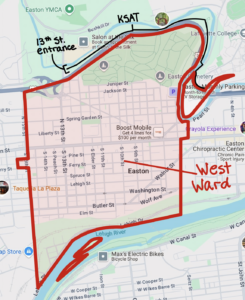
Map showing the location of the West Ward neighborhood in Easton
The map in Figure 9 map provides an update to Figure 1. The site closest to the 13th Street entrance can serve as a direct connection to the West Ward neighborhood. The location near the dog park would benefit users who spend their time on the opposite end of the trail, a trend revealed in our survey results. Finalized locations will be outlined in the Technical Context section, as site decisions are also influenced by whether an area receives adequate sunlight for solar panel operation.
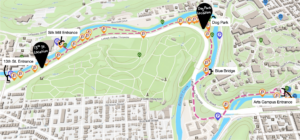
Figure 9: Installation Locations
Broader political factors that may influence the project include permitting, as well as prevailing attitudes surrounding funding for the arts. Permission for breaking ground will likely need to be obtained, holding installation teams accountable for changes to land use and the immediate environment (Wilford-Hunt 2024). Easton Public Works maintains the KSAT and is expected to be involved with its newest addition. Additionally, local and national views on the importance of art can play a role in determining continued support for the Spoken Word. The project’s initial reception has the potential to impact financial contributions and publicized assistance from local officials, especially as the City of Easton continues its revitalization efforts (Toia 2024). Thus, our team has prioritized promoting the project in a positive and flexible manner to strengthen visibility.