The Karl Stirner Arts Trail (KSAT) is a public sculpture park and walking trail located in Easton, Pennsylvania. The path follows the curves of Bushkill Creek, a local waterway and valuable community asset. Built in 2011, the 1.75-mile trail now provides a connection between Lafayette College’s Arts Campus, downtown Easton, the Simon Silk Mill residential and commercial complex, and Easton’s West Ward neighborhood. The KSAT is named after Karl Stirner, who was a prominent sculptor and longtime advocate for the arts within Easton. In alignment with Stirner’s values, the purpose of the KSAT is to connect art with nature, history, health, and wellness (Karl Stirner Arts Trail 2024).
KSAT stakeholders and contributors strive to cultivate a recreational experience that is also educational and engaging for all users via the incorporation of physical components. These include a labyrinth, a student art wall, and a series of thought-provoking sculptures. The KSAT Advisory Board, which oversees trail management, recently received funding to support a new project highlighting the art of poetry. Our team of senior Engineering Studies students was able to contribute to the final product via an initiative known as “The KSAT Spoken Word Project.” Its objective is to showcase the work of writers from the Lehigh Valley via a series of installations, with each one dedicated to a different local poet, that will allow KSAT users to listen to poems as they experience the trail.
Though still in its beginning stages, this project is multifaceted. Our team explored the social context and political history of Easton as it impacts trail use, the technical and artistic aspects of potential designs, and additional project constraints pertaining to economics and the environment. The Spoken Word will be a valuable addition to the KSAT, as it celebrates local talent and aligns with the trail’s mission of connecting art with experiences of the natural world.
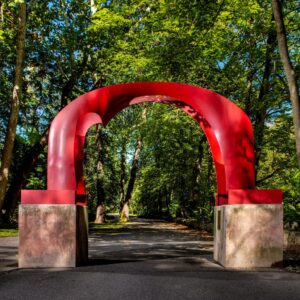
Figure 1 depicts a current map of the trail. The orange pinpoints containing a red archway, which is the KSAT logo and the trail’s most recognizable landmark, represent art installations currently placed along the route. The green pinpoints denote places of interest, including the Simon Silk Mill complex, the dog park, and the Historic Easton Cemetery. The purple pinpoints containing a “P” indicate parking areas and are closer to where many users enter or exit the trail. Learning about the existing setup of the KSAT allowed our team to begin visualizing how new installations would best be incorporated into the trail.
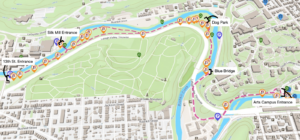
Figure 1: KSAT Landmark Map
Our initial research, composed of site visits, a user survey, and interviews with both engineering experts and community members, allowed us to formulate our problem statement:
How might we create meaningful poetry installations that are engaging and accessible for all users?
We initially proposed two potential solutions, sketched out in Figure 2, to address this question. Both options would use solar energy to power a speaker with the capability to play a pre-programmed recording of a poem in an outdoor environment. Their main difference stems from how the recording would be activated. In Option 1, the audio is triggered by a motion sensor, so when someone steps underneath the laser sensor, the speaker will activate and begin playing. In Option 2, the audio is turned on by a manual button. Considering the higher power demands that accompany the motion sensor, our team determined that the structure of Option 1 would need to be connected to a local electricity grid to support all of its energy needs. We drew from these energy considerations, as well as material concerns, to devise Option 2, which includes a waterproof box to protect the speaker in the absence of the cone from Option 1.
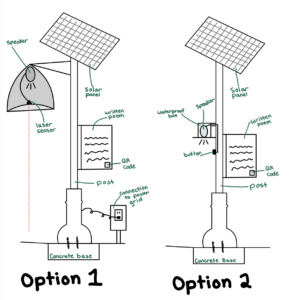
Figure 2: Initial Proposed Solutions
Further design iteration prompted us to consider the integrity of the structure’s internal components and intended equipment. Not only would weatherproofing be a requirement for the speaker box, but it would be necessary to clearly let sound waves pass through and allow for easy maintenance access while withstanding any unwanted tampering with the box. To better protect the audio components, our final design iteration incorporates three aluminum panels to enclose all inner workings of the structure. As shown in the prototype and cross-section included in Figure 3, the front panel will provide space for the push button, the speaker output, and written versions of a featured poem, while the back panels will have room for visual art related to the poem’s content. We believe that this version, referred to as Option 2B, best combines energy, material, and accessibility concerns. Thus, we recommend Option 2B as the solution most suited to accomplishing the goals of the KSAT Spoken Word Project.
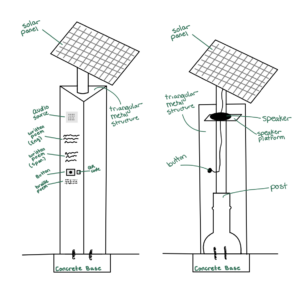
Figure 3: Final Proposed Solution