Objective and Design Philosophy
The goal of this device is to develop a smart lighting system able to be easily controlled by a disabled resident or their caregiver. The system is designed to function as a reliable and safety regulation-compliant lighting system for the smart home. Emphasis is placed on ease of use and safety in case of a power outage.
Core Components
The system is built around the following hardware and software elements:
- LM2675N Buck Converter: Converts power input to the correct voltage for use by the pico (5V)
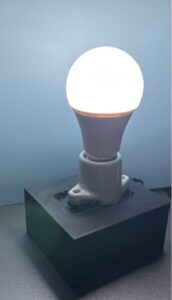
- 7 Watt Replaceable LED Light Bulb: Emits light when toggled for the lighting system
- Backup Battery: Backup battery automatically powers the light during power cuts, for up to 90 minutes as per the National Fire Protection Association 101 Life Safety Code
Implementation Strategy:
This implementation uses a very simple commercial light bulb for cheap and easy replacement. Control of the light is achieved by using the PicoW_HomeAssistant_Start project as a base to control a GPIO pin. This pin connects to a transistor which allows the Pico to toggle a higher voltage light.
Engineering Challenges and Solutions
- Concern about the high voltage of the light frying the Pico. An optoisolator was used to make sure the Pico did not receive too much power.
Performance:
The lights are able to be toggled using the Kick Buttons, directly through the Smart Mobile Device interface, and from the Remote Support Station website. The light bulb is bright, but not too hot, and turns on in a timely fashion after being wirelessly prompted.