Objective and Design Philosophy
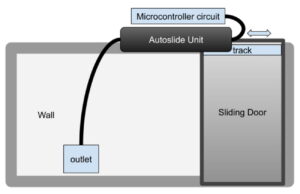
The Smart Door Opener is designed to allow the resident more control over their door. When the resident or support staff chooses to open or close the door, the Smart Hub takes that command and sends it to a microcontroller to open/close the door. The power supply for the door opener comes from a wired connection to a power outlet, and the door opener powers the microcontroller that connects to the Hub.
Core Components
The system is built around the following hardware and software elements:
- Autoslide Sliding Door Opener: Opens and closes the door in response to a relay closing. Includes collision detection.
- Pi Pico W: Connects to the Hub to enable wireless control via the MQTT protocol. Also includes code to integrate with the Home Assistant.
- G5LE-1 DC12 12V Relay: Allows the Pi Pico W to control the Door opener
- TLV2217-33KCSE3 Liner Regulator: Converts wall power to a lower voltage for the Pi Pico W
Implementation Strategy:
The Autoslide commercial sliding door opener is the actuation mechanism due to its built-in safety features, such as collision detection. The Autoslide system includes relay cable ports that allow for external input control, enabling integration with third-party hardware. Smart control is achieved using a modification of the PicoW\_HomeAssistant\_Starter project to control a GPIO pin. The GPIO pin connects to a simple circuit that toggles a relay, which in turn activates the door opener via these ports.
Engineering Challenges and Solutions
- We initially planned to connect the GPIO pins to the fob remote that came with the Autoslide system. The chip inside the fob was not meant to be soldered and easily broke the connections. In addition, it did not reliably trigger the inside sensor on the Autoslide Computer Unit, so we decided to go with a relay instead.
- Mechanical/installation issues with smooth sliding of the door. This was resolved by re-installing the door.
Performance:
The device operates with the HA website, through the UI of the SMD, through the SALE-R buttons, and through manual control. Latency is negligible.