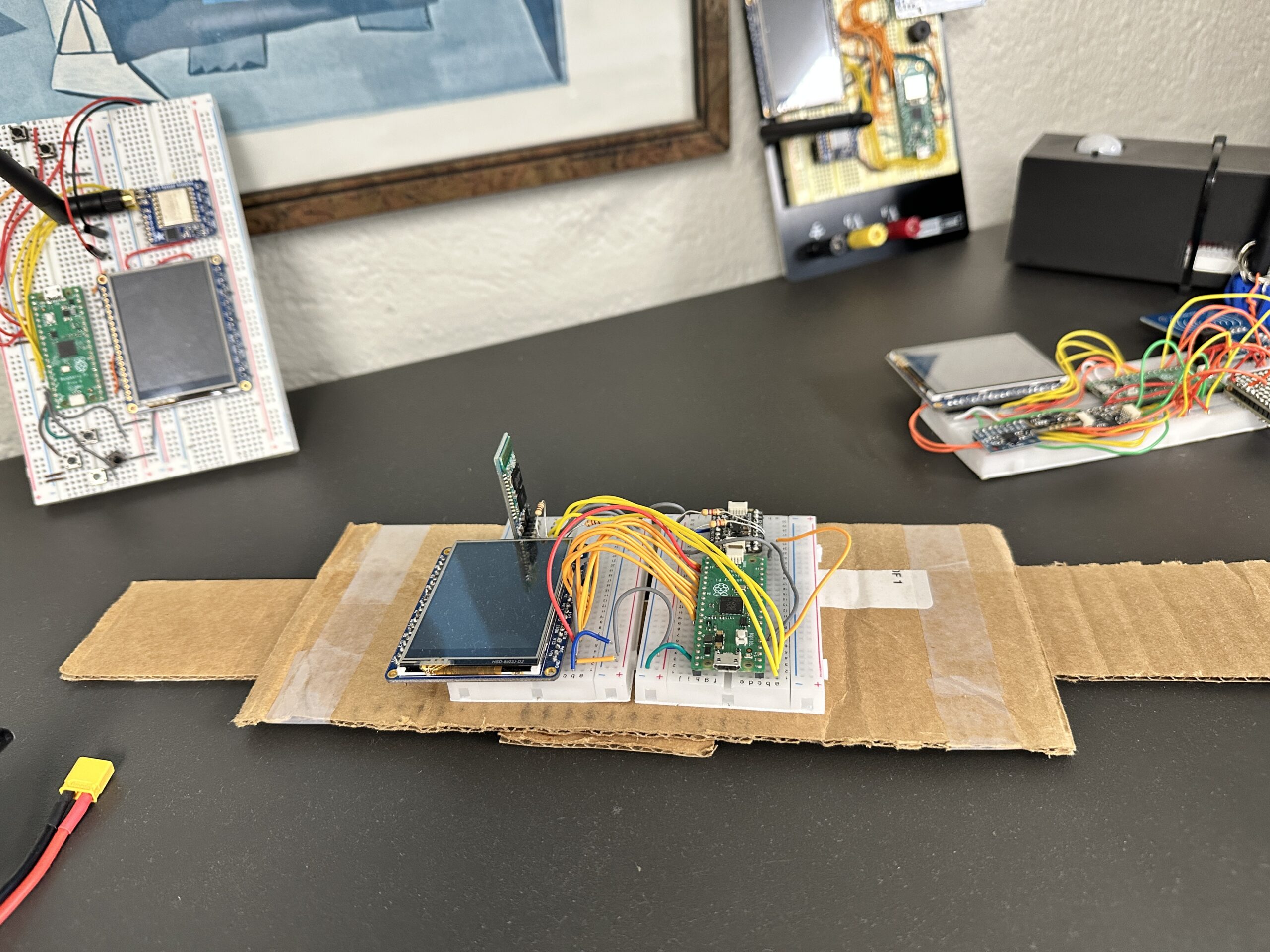
Project Title: Wearable Health Monitor Device – A Secure, Multi-Sensor Health Tracker
Team Members: Qinwen Deng, Nam Vu
Course: ECE 414 – Embedded Systems
Project Overview
In response to the high cost of commercial health wearables, this project aimed to design and implement a cost-effective, embedded wearable health monitor. The device integrates an array of essential sensors to track key physiological and environmental metrics, providing users with valuable health data. A focus on accessibility and data privacy ensures the device is both practical and secure for personal use.
Key Features & Objectives
The system was designed with the following core capabilities:
-
Secure User Authentication: The device is locked on startup and requires a specific RFID card to unlock, ensuring user data privacy.
-
Comprehensive Health Monitoring: Once unlocked, the device displays real-time data including:
-
Heart Rate (BPM) from a pulse oximeter.
-
Ambient Temperature and Humidity.
-
Ambient UV Index.
-
User motion via accelerometer magnitude.
-
-
Visual Heartbeat Feedback: An LED matrix synchronizes its flashing pattern with the user’s detected heart rate, providing a clear visual indicator of pulse.
-
Real-Time Data Display: A colorful and intuitive LCD touchscreen interface presents all sensor data, updating every second to provide immediate feedback.
Technical Implementation
Hardware Core:
The device is built around a single Raspberry Pi Pico (RP2040) microcontroller that integrates a wide array of sensors and peripherals:
-
Microcontroller: Raspberry Pi Pico (RP2040)
-
User Interface: Adafruit 2.4” TFT LCD Touchscreen (SPI)
-
Biometric Sensor: MAX30102 Pulse Oximeter and Heart-Rate Sensor (I2C)
-
Environmental Sensors:
-
DHT20 Temperature and Humidity Sensor (I2C)
-
LTR390 UV Sensor (I2C)
-
-
Motion Sensor: MPU6050 Accelerometer and Gyroscope (I2C)
-
Security: RC522 RFID Reader (SPI) for user authentication.
-
Visual Feedback: IS31FL3731 LED Matrix Driver (I2C)
Software & Framework:
-
Framework: Arduino
-
Architecture: The software is structured around a Finite State Machine (FSM) with two primary states:
DEVICE_LOCK(waiting for RFID) andDEVICE_UNLOCK(active monitoring). -
Integration: A single main file orchestrates the reading of all sensors, data processing, and display updates, leveraging specialized libraries for each hardware component.
Challenges & Adaptations
The project involved significant integration challenges that were successfully overcome:
-
Multi-Sensor Integration: Coordinating six different I2C and SPI devices on a single microcontroller required careful management of pin assignments and communication protocols.
-
Library Compatibility: Sourcing and integrating multiple third-party libraries from GitHub for the various sensors was a complex task essential for functionality.
-
Power Management: Ensuring stable 3.3V power for all components from the Pico was critical for reliable sensor readings.
-
User Interface: Designing a clear and informative display layout to present multiple data streams simultaneously without cluttering the screen.
Results & Demonstration
The final prototype successfully operates as a proof-of-concept health monitor. The device:
-
Securely remains in a locked state until the correct RFID card is presented.
-
Unlocks and immediately begins displaying real-time sensor data on the LCD.
-
Accurately measures and displays heart rate, with the LED matrix flashing in sync with the user’s pulse.
-
Reliably reports temperature, humidity, UV index, and motion data.
-
Updates all information on the screen at a rate of once per second, meeting the specified performance requirements.
Conclusion & Future Work
This project successfully demonstrates a functional, low-cost prototype for a multi-sensor health monitoring wearable. It effectively combines data privacy, user feedback, and a wide range of health and environmental metrics into a single, integrated device.
Potential future enhancements could include:
-
Integrating a GPS module to track user activity and distance traveled.
-
Associating RFID cards with personalized user profiles (name, age, weight) for customized health tracking.
-
Implementing a fully functional touchscreen interface for richer user interaction beyond the basic logout button.
-
Adding data logging capabilities to track health metrics over time.
The project required approximately 24 hours of work per team member over four weeks.